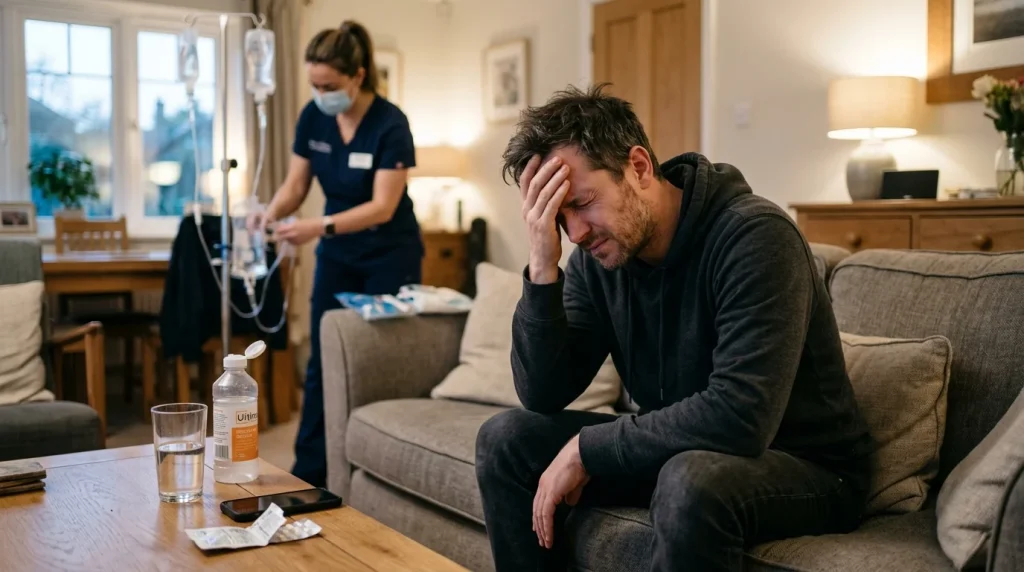
Hangover anxiety arrives before the headache does. A tight chest. A replay reel of last night on a loop. A feeling that you have done something wrong, even when nothing happened. It is one of the least discussed parts of a hangover, and one of the most unsettling.
It is chemistry, on a fairly predictable schedule, not a signal your instincts are sending you. Here is what is happening, how long it lasts, and what genuinely helps.
Key things to know
- It is a rebound effect, not evidence that something went wrong last night.
- It is common. Research summarized by The Conversation puts it at roughly 22 percent of social drinkers.
- Four things drive it at once: neurotransmitter rebound, cortisol, disrupted sleep, and dehydration with low blood sugar.
- It usually peaks in the first hours after waking and fades within about 24 hours.
- Anxiety that keeps returning, or shows up between drinking occasions, is worth raising with a clinician.
Why hangover anxiety matters
Most hangover advice covers the physical symptoms and treats the mental side as a footnote. That leaves people assuming the dread they feel is information about their life rather than a symptom, so they cancel plans, replay conversations, and apologize for things nobody noticed. Knowing it is chemical and time limited changes how you sit with it.
How common hangover anxiety is
Roughly 22 percent of social drinkers experience anxiety as part of a hangover, per research summarized by The Conversation. The National Institute on Alcohol Abuse and Alcoholism lists anxiety alongside irritability, sweating, and raised blood pressure among hangover symptoms. It is a recognized part of the picture.
Who feels it most
People who already live with anxiety feel it harder, and so do people who drank quickly, drank a lot, or slept badly afterward. Drinkers who are naturally self monitoring in social settings report the sharpest version, because the rebound lands on a mind already scanning for missteps.
What causes hangover anxiety
Four mechanisms overlap, and they do not peak at the same moment. That is why the morning has an arc rather than one flat bad feeling.
GABA and glutamate rebound
Alcohol increases the effect of GABA, the neurotransmitter that dampens brain activity, and suppresses glutamate, which does the opposite. That combination is the calm you feel early in an evening, and your brain adjusts in the other direction to stay balanced.
Why the calm reverses
When the alcohol clears, the adjustment is still in place. GABA activity drops below normal and glutamate climbs, so the brain sits over excited for several hours. That reads as restlessness, dread, and thoughts that will not slow down.
Cortisol and the stress response
Drinking raises cortisol, the hormone that runs your stress response. In the morning that contributes to a fast heartbeat, difficulty settling, and waking earlier than you meant to. The physical alarm arrives before you have decided anything is wrong.
Broken sleep
Alcohol shortens REM sleep and fragments the night, even when you fell asleep quickly and stayed down for eight hours. A short night lowers your threshold for anxiety on its own, so this compounds the other mechanisms rather than adding to them politely. The same disruption is worth understanding if you are looking at IV therapy and sleep quality.
Dehydration, electrolytes, and blood sugar
Alcohol increases urine output, pulling out fluid and electrolytes including sodium and potassium, and it interferes with how your liver maintains blood sugar overnight. The result is shakiness, a racing pulse, and light headedness. Your brain reads those signals as threat, which is why the body side and the mind side feed each other. Preventing dehydration in Las Vegas covers the local version of that problem.
How long hangover anxiety lasts
For most people it runs from a few hours to about a day, and it is worst early. Cleveland Clinic describes peak symptoms in the first hours after waking, easing across the following 24 hours as the brain returns to baseline.
The first few hours after waking
This is where the rebound, the cortisol, and the sleep debt land together. It is also when the thoughts feel most convincing, which is precisely when they are least reliable. Treat what your mind concludes about your character in this window as a symptom, not a verdict.
When it should be fading
By the afternoon or the next morning most people notice a clear drop. If it is still at full strength more than a day later, or it arrives after every drinking occasion, that pattern is worth a conversation with a clinician rather than another recovery morning.
What actually helps the morning after
Nothing here ends the rebound early. What these do is take the amplifiers away, so the rebound is all you are managing, and give you something to do while it passes.
What hydration does, and what it does not
We deliver IV hydration for a living, so we will be precise rather than vague. Fluids and electrolytes address one part of a hangover: the fluid and electrolyte loss and the physical symptoms that come with it. For a lot of people that is the difference between a rough morning and a functional one.
What fluids do not do is reverse the neurotransmitter rebound or replace the sleep you lost. Those resolve on their own timeline. Anyone telling you an IV removes hangover anxiety is describing something other than what the fluid is doing. For what a bag contains and how a visit runs, see what a hangover IV includes.
The honest version: partial relief on the physical layer, with individual results varying, while the mental layer follows its own clock.
Common myths about hangover anxiety
Myth: a drink the next morning fixes it
It postpones it. More alcohol re raises GABA activity and pushes the rebound down the road, so the relief is brief and the eventual landing is often harder. It is also worth noticing without judgment, because regularly drinking to settle the after effects of drinking is one of the signals clinicians ask about.
Myth: feeling anxious means you did something embarrassing
The feeling arrives with no triggering event behind it. People report the full experience after quiet evenings where nothing happened. The chemistry generates the dread, then your mind goes looking for a reason to attach it to, and it usually finds one.
Myth: an IV takes hangover anxiety away
An IV replaces fluids, electrolytes, and vitamins, which addresses dehydration. It is not a treatment for anxiety and it does not undo lost sleep or shorten the rebound. Understanding how mobile IV therapy works makes that boundary clear before you book anything.
When to talk to a provider
A rough morning after a night out is ordinary. A pattern is a different conversation, and one clinicians have without judgment many times a week.
Signs worth raising with a clinician
- Anxiety that is still at full strength more than a day later.
- Anxiety that appears between drinking occasions, not only after them.
- Drinking to relieve the after effects of drinking.
- Tremor, panic episodes, or anxiety that has been building over months.
- Anxiety that is changing what you do, who you see, or how you work.
None of these means something has gone irreversibly wrong. They mean the question is bigger than one morning, and a clinician has better tools for it than a recovery routine.
When it is not a hangover at all
Confusion, repeated vomiting, a seizure, chest pain, trouble breathing, or someone who cannot be roused are medical emergencies, not hangovers. Call 911 or go to an emergency room. IV hydration is supportive care and is not a substitute for emergency treatment. If you are pregnant, or if severe symptoms are worsening rather than easing, seek care rather than waiting the morning out.