Stop drinking, sit up, and take a small sip of something clear every few minutes instead of a full glass. Small amounts, often, is what MedlinePlus advises for nausea and vomiting of any cause, and it matters more after a night of drinking, when a big gulp tends to come straight back up.
Then give it time. The National Institute on Alcohol Abuse and Alcoholism (NIAAA) is plain that nothing ends a hangover except time, and its symptoms can last 24 hours or longer. What you can control is getting fluid in without setting off the vomiting again, and noticing the few signs that mean this has stopped being a hangover. That is the choice in front of you right now: ride it out, have a clinician come to your room, or go to an emergency room.
What to Do in Your Hotel Room in the Next Hour
When Vomiting Means the ER, Not a Drip
Vomiting together with any other sign of an alcohol overdose is an emergency: call 911. NIAAA's list of those signs is confusion or stupor, trouble staying conscious or waking up, vomiting, seizures, slow or irregular breathing, a slow heart rate, clammy skin, no gag reflex, and a very low body temperature with bluish or pale skin, and it warns not to wait for all of them. Stay with the person, have them lean forward if they are vomiting, and roll them onto one side if they can't stay awake. Cold showers, coffee and walking it off do not reverse an overdose and can make it worse.
For someone who is awake, making sense and vomiting, MedlinePlus draws clear lines:
- Blood, or dark material that looks like coffee grounds, in the vomit: call 911 or go to an emergency room.
- Vomiting for longer than 24 hours.
- Not keeping any fluids down for 12 hours or more.
- No urine for 8 hours or more.
- Severe pain in the stomach or belly.
- A headache or a stiff neck.
For any of the last five, contact a doctor or get medical care right away.
Vomiting blood also rules out a drip in your hotel room. The Hangover IV contains ketorolac (Toradol), an anti-inflammatory pain reliever, and its prescribing information says it must not be given to anyone with recent bleeding in the stomach or intestines or an active ulcer. Blood in the vomit needs an emergency room, where the cause can be found.
Why Your Stomach Turns as the Alcohol Wears Off
Alcohol irritates the lining of the stomach and makes it release more acid, and it sets off inflammation throughout the body (NIAAA). The symptoms peak as blood alcohol drops back toward zero, which is why the nausea often arrives the next morning rather than at the bar. Two 2020 papers from one research group found that people with higher inflammation markers had worse hangovers, and so did people whose bodies cleared alcohol more slowly (van de Loo, 2020; Mackus, 2020).
That is why the advice is sips, not glasses: small amounts are easier for an irritated stomach to keep down. It is also why water alone does not switch the nausea off. The stomach and the inflammation settle on their own timetable.
Hangover remedies sold for the purpose don't change that. Reviews of the controlled trials found no compelling evidence that any hangover remedy works, and only very low-quality evidence for the few that showed an effect (Pittler, 2005; Roberts, 2021).
Does Zofran Work for a Hangover?
It may help a little, and not on its own. No trial has tested ondansetron, the medicine sold as Zofran, on hangovers, and in emergency department trials of nausea from other causes it did not do significantly better than a saline drip.
What Ondansetron Is and What It Does
Ondansetron is a prescription anti-nausea medicine. It blocks a type of serotonin receptor, called 5-HT3, found on the nerves that run from the gut to the brain and in the part of the brain that triggers vomiting. Its prescribing information notes that exactly where it acts has not been fully worked out. It is best known for preventing the nausea that comes with chemotherapy, radiation treatment and surgery.
What the Studies Found
The hangover evidence is thin. A trial of tropisetron, a drug from the same family, found no significant difference from placebo (reviewed in Pittler, 2005).
The closest evidence comes from emergency departments. In two randomized trials in Melbourne, adults with nausea from all kinds of causes were given IV ondansetron or a saline placebo. Nausea eased in both groups, and the difference between them was not statistically significant (Egerton-Warburton, 2014; Meek, 2018). A commentary on the second trial drew the practical conclusion: start with IV fluids, and consider medicine if the nausea carries on (Sampson, 2019).
That points to fluids and time doing much of the work, with the medicine adding to them for some people. A drip gives you both at once.
Who Shouldn't Take It
Its prescribing information rules it out for anyone allergic to ondansetron and for people taking apomorphine. It warns about a heart rhythm change called QT prolongation, and says people born with long QT syndrome should avoid it. It also warns about serotonin syndrome, mostly in people taking other drugs that act on serotonin, such as SSRI and SNRI antidepressants, tramadol and lithium. That is why the medication list you wrote down matters before anyone gives you a dose.
When Water Won’t Stay Down: What a Drip Adds and What It Costs
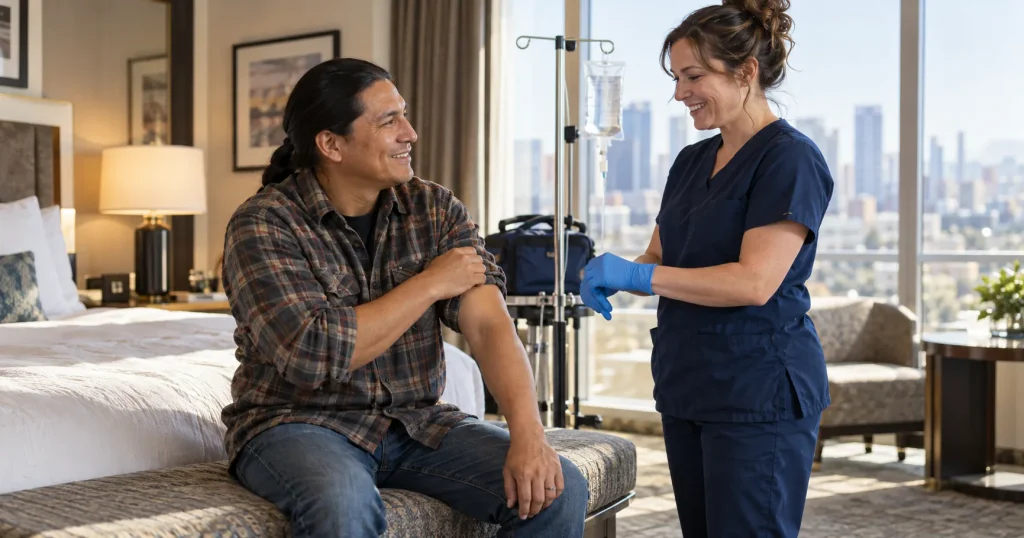
If small sips keep coming back up, none of the emergency signs above apply, and you are short of the 12-hour line, that is when a visit earns its cost. A drip puts a liter of fluid into a vein, so it bypasses digestion entirely, and the anti-nausea medicine goes in the same way instead of as a tablet your stomach has to hold on to. It does not end a hangover, and nobody can promise how soon you will feel better.
The Hangover IV is $250 and takes about 45 minutes. The bag holds 1,000 ml of saline or lactated Ringer's with vitamin C, B-complex, B12 and magnesium, plus two prescription medicines: ondansetron (Zofran) for nausea and ketorolac (Toradol) for pain. Licensed nurses and NREMTs give the drips, with medical oversight by our Medical Director, Dr. Daniel Olivero, MD.
The page for the Hangover IV walks through the visit itself. When you are ready, book online and pick a time. A $50 deposit is taken when you book and credited to your total, and visits between 8 PM and 7 AM add a $99 after-hours fee.
Why Some Hangovers Last Two Days
A hangover can last 24 hours or longer (NIAAA), and a second bad day can have more than one cause. Sleep after drinking is broken up, even when you fall asleep quickly (NIAAA). And a body that clears alcohol slowly still has more of it circulating the next morning; in those 2020 papers, that later exposure, and the inflammation that comes with it, went with worse hangovers (Mackus, 2020; van de Loo, 2020). On a weekend of back-to-back nights, there is less time to recover between them, which is what the guide to F1 and NFR weekend recovery plans around.
If you are still vomiting on the second day, the MedlinePlus lines above apply: vomiting for more than 24 hours, or 12 hours without keeping fluids down, is a reason to get medical care rather than wait for day three. For the next trip, there are nine ways to avoid one in the first place.
More Questions About Hangover Nausea
Sources
- National Institute on Alcohol Abuse and Alcoholism. Hangovers.
- National Institute on Alcohol Abuse and Alcoholism. Understanding the Dangers of Alcohol Overdose.
- MedlinePlus. Nausea and vomiting, adults.
- Ondansetron hydrochloride tablets, prescribing information. DailyMed.
- Ketorolac tromethamine injection, prescribing information. DailyMed.
- Meek R, et al. Randomized placebo-controlled trial of droperidol and ondansetron for adult emergency department patients with nausea. Academic Emergency Medicine, 2018.
- Egerton-Warburton D, et al. Antiemetic use for nausea and vomiting in adult emergency department patients. Annals of Emergency Medicine, 2014.
- Sampson C. In adults in the emergency department with nausea, neither droperidol nor ondansetron improved symptoms. Annals of Internal Medicine, 2019.
- deSouza I, et al. Efficacy and safety of pharmacologic therapies for nausea and emesis in the emergency department. Annals of Emergency Medicine, 2025.
- Pittler MH, Verster JC, Ernst E. Interventions for preventing or treating alcohol hangover: systematic review of randomised controlled trials. BMJ, 2005.
- Roberts E, et al. The efficacy and tolerability of pharmacologically active interventions for alcohol-induced hangover symptomatology. Addiction, 2021.
- van de Loo AJAE, et al. The inflammatory response to alcohol consumption and its role in the pathology of alcohol hangover. Journal of Clinical Medicine, 2020.
- Mackus M, et al. The role of alcohol metabolism in the pathology of alcohol hangover. Journal of Clinical Medicine, 2020.
- Li ZY, et al. Ginger for treating nausea and vomiting: an overview of systematic reviews and meta-analyses. International Journal of Food Sciences and Nutrition, 2023.