Convention season in Las Vegas opens with CES in early January and peaks again in spring and fall. Whether you're here for a tech expo, a trade fair or a medical conference, the week goes better with a plan for water. Make it before your flight lands.
What a convention day does to your water
Healthy adults keep their water balance remarkably well from day to day, as long as food and fluid are readily available, according to a review of human water needs (Sawka, 2005). A show day quietly removes the second half of that sentence. The keynote runs long, the next session is on the far side of the building, and nobody covers the booth while you go looking for a refill.
Then there's everything else a convention asks of you. You talk for hours, in dry desert air. You stand far more than you sit. Most evenings end at a reception with an open bar, and most mornings start earlier than the night before allowed for.
The early signs are easy to blame on the show itself. MedlinePlus lists thirst, a dry or sticky mouth, not urinating much, darker yellow urine and headache among the first ones.
Mild dehydration also shows up in how you think. In a study of 25 healthy young women, losing about 1.4 percent of body weight in water lowered mood and concentration, made tasks feel harder and brought on headaches (Armstrong, 2012). A study of 26 young men, at about 1.6 percent, found slower working memory, more errors on a vigilance task, and more fatigue and tension (Ganio, 2011). Both were lab studies in which exercise caused the fluid loss. Concentration and working memory are still what a day of meetings and pitches runs on.
When it's more than a long day
A few signs aren't part of a hard show week.
MedlinePlus also lists the signs of severe dehydration: not urinating at all or very dark, amber urine, dizziness or lightheadedness, and a rapid heartbeat. MedlinePlus calls severe dehydration a life-threatening emergency, so any of those means emergency care now, whatever the schedule says. If a colleague faints on the show floor or can't follow a conversation, call 911.
A water plan built around the show schedule
The plan that works is the one that doesn't depend on remembering. Attach water to moments the day already has.
- Before you leave the room. Drink a full glass with breakfast or the first coffee, and take a filled bottle with you.
- After a morning workout. Drink for that too: strenuous exercise can greatly increase daily water needs (Sawka, 2005).
- At every session change. Refill before you sit down for the next one, not when you notice you're thirsty.
- At the booth. Keep the bottle where you stand, not in a bag under the table.
- At lunch. Eat an actual meal. Water in food counts toward the day's total (Sawka, 2005).
- At the reception. Have a glass of water with each drink.
- Before bed. One more glass, especially after a late one.
Coffee counts. In a 2014 study of 50 men who usually drank three to six cups a day, four cups of coffee a day kept them as well hydrated as the same amount of water (Killer, 2014). If you're a regular coffee drinker, the morning cup isn't working against you.
Alcohol is different. It suppresses vasopressin, the hormone that signals the kidneys to hold on to fluid, so you urinate more and lose more fluid (NIAAA). That's why the glass of water per drink matters more than anything you do about coffee.
The cost of this plan is more trips to the restroom, so take those at the session changes too. For a quick check, look at the color of your urine. Pale is what you're aiming for.
Does an IV drip help during a show week?
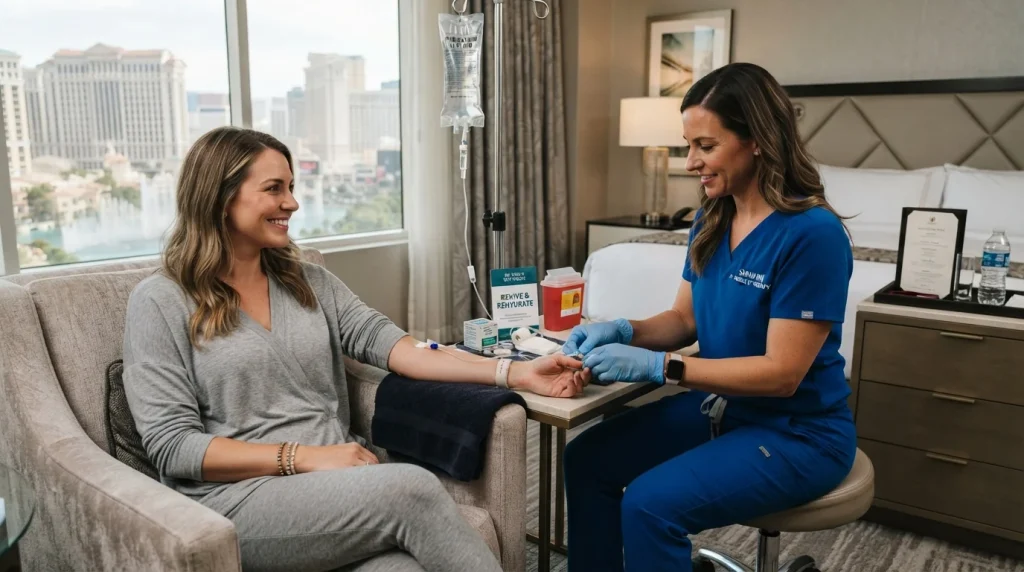
An IV drip puts fluid straight into the bloodstream, so it doesn't depend on you finding time to drink. The Hydration IV is a liter of normal saline (1000 ml) with vitamin C, B-complex and B12, and the drip itself takes about 45 minutes. That's its real advantage on a show day: the water goes in while you sit still, whether or not the day gave you a chance.
Drinking does nearly as well when you have the chance. In one small study of eight men dehydrated by exercise in the heat, an IV restored blood plasma volume faster than drinking the same fluid. When they exercised in the heat again afterwards, though, the IV gave them no advantage over the drink (Kenefick, 2006). Those men had been exercising in the heat, not standing at a booth, so the comparison is a rough one. If you've kept up with the plan above, a drip adds little.
Where a drip earns a place is the day you can see coming: the one with back-to-back meetings and no gaps, or the day after a late night that left no room for water. Booked for the evening before that day or first thing that morning, a drip gets a liter in without relying on the schedule. It won't replace sleep, and it doesn't excuse skipping the water plan.
Timing a drip around the show
Book on the spot and you're in the arrival window: usually 45 to 60 minutes, with the Strip and Downtown typically fastest. At peak times, which include weekend mornings, holidays and convention weeks, arrival can take up to 90 minutes, and the 45-minute drip starts after that. Booking ahead lets you choose the time in the booking system instead. Deciding at 7:30 a.m. that you need a drip before a 9 a.m. keynote is a gamble.
The clock matters for price too. Any visit between 8 p.m. and 7 a.m. carries a $99 after-hours fee, and those are the hours a convention visitor tends to reach for: straight after the reception, or at dawn before an early call.
So look for the gaps outside that window. If your hardest day starts late, book its morning, any time after 7 a.m. If it starts early, book the evening before, in the hour between the floor closing and dinner, if that evening has one. Plan for the drip to be in and done before 8 p.m. If the only time you have is after the reception, you can still book it. It just costs the extra $99.
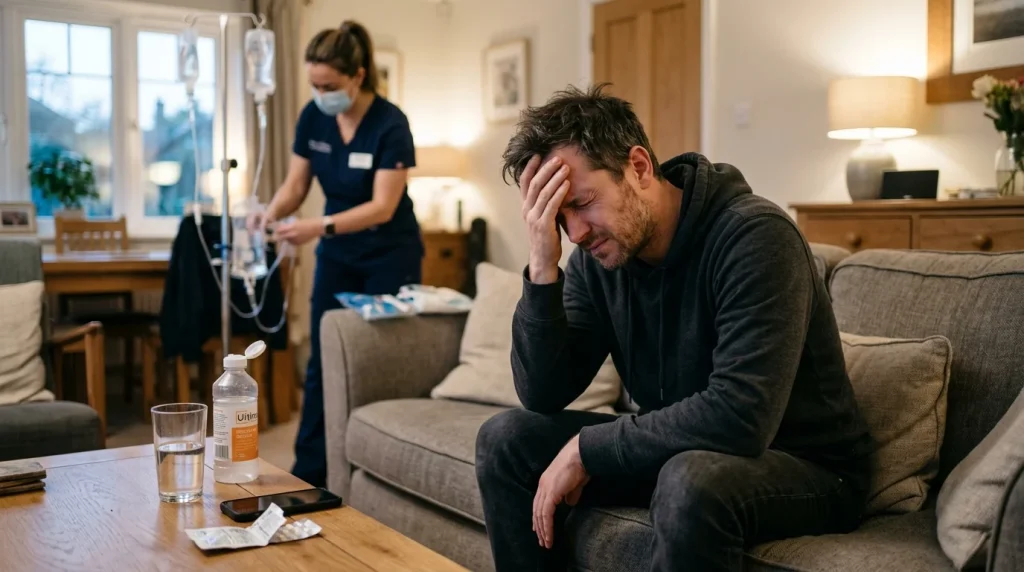
Drips are given by licensed nurses and REMTs (registered emergency medical technicians), in your hotel room or at an office.
What's in the bag in detail, and who shouldn't have one, is on the page for the Hydration IV, which is also where you book it.
If you're here for CES
CES fills the city in early January, and convention weeks are when arrival stretches, so CES is the week to book ahead rather than on the spot. Decide now which day will be your hardest and where its gaps are.
January also takes away the reminder most people rely on. There's no heat to make you thirsty, but the days are just as long, so the water plan matters as much in January as it would in July.
Flying in the morning the show opens adds a different problem, and recovering after a long flight has its own set of fixes.
Other things worth knowing
Sources and References
- MedlinePlus. Dehydration. Reviewed July 1, 2025. medlineplus.gov/ency/article/000982.htm
- Sawka MN, Cheuvront SN, Carter R. Human water needs. Nutrition Reviews. 2005;63(6 Pt 2):S30-S39. doi.org/10.1111/j.1753-4887.2005.tb00152.x
- Armstrong LE, Ganio MS, Casa DJ, et al. Mild dehydration affects mood in healthy young women. The Journal of Nutrition. 2012;142(2):382-388. doi.org/10.3945/jn.111.142000
- Ganio MS, Armstrong LE, Casa DJ, et al. Mild dehydration impairs cognitive performance and mood of men. British Journal of Nutrition. 2011;106(10):1535-1543. doi.org/10.1017/S0007114511002005
- Killer SC, Blannin AK, Jeukendrup AE. No evidence of dehydration with moderate daily coffee intake: a counterbalanced cross-over study in a free-living population. PLoS One. 2014;9(1):e84154. doi.org/10.1371/journal.pone.0084154
- National Institute on Alcohol Abuse and Alcoholism. Hangovers. niaaa.nih.gov
- Kenefick RW, O'Moore KM, Mahood NV, Castellani JW. Rapid IV versus oral rehydration: responses to subsequent exercise heat stress. Medicine & Science in Sports & Exercise. 2006;38(12):2125-2131. doi.org/10.1249/01.mss.0000235358.39555.80