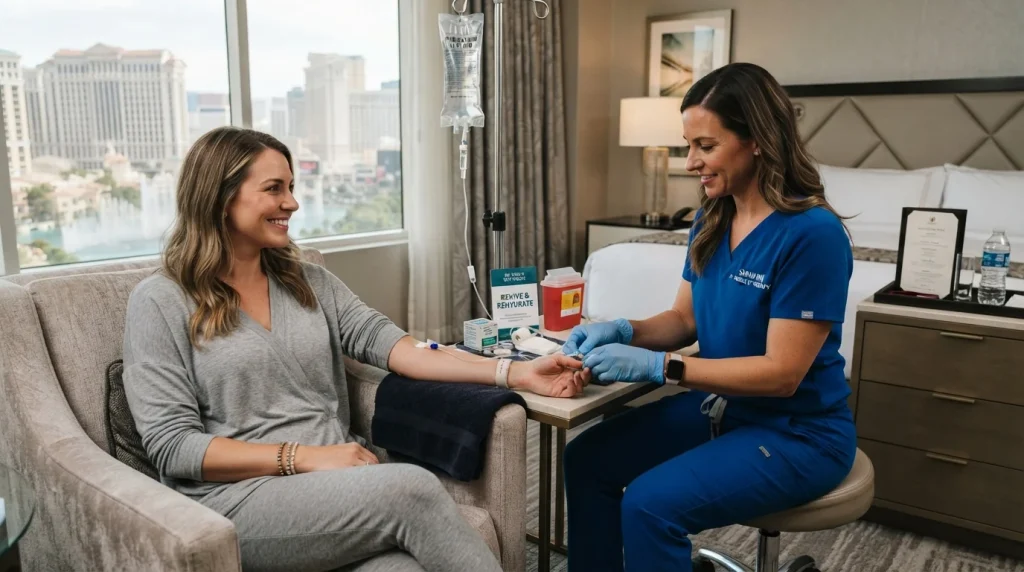
Letting someone put an IV in your arm at home or in a hotel room is a reasonable thing to pause over. Most of what can go wrong falls into two groups: problems from the needle sitting in a vein, and problems from what runs through it. Once you know which is which, you can check your own health against the short list that matters and know what to say before anything starts.
Is a mobile IV safe for most adults?
- 1 The common side effects come from the needle
- 2 What are the complications of IV therapy?
- 3 What goes into the vein matters as much as the needle
- 4 Who should talk to a doctor first, and when to stop the drip
- 5 Who administers mobile IV therapy in Las Vegas?
- 6 Each drip is booked on its own page
- 7 More questions about mobile IV side effects
- 8 Sources
The common side effects come from the needle
A small bruise or a sore spot where the needle went in is the most likely thing you'll notice, and it usually fades on its own.
Two other problems belong to the vein itself. Sometimes fluid leaks into the tissue around the vein instead of into it, which shows up as swelling at the site; clinicians call this infiltration. Sometimes the vein gets irritated and inflamed, called phlebitis, which brings swelling, pain, redness, and warmth and tenderness along the vein. A large review of peripheral IVs found these two were the most common complications. Its numbers come mostly from hospital patients whose catheters stayed in for days, so they don't translate directly to a single drip. If the site starts to hurt, burn or swell while the drip is running, say so right away; it's a quick thing to check.
Why some people feel faint when the IV goes in
Some people get lightheaded, sweaty or faint as the needle goes in. It is a reflex, not a reaction to the drip. In one study of 300 outpatients aged 18 to 40, 12.6% of those sitting up had this reaction during IV placement, against 2.1% of those lying back, and people who reacted were more likely to have fainted before. Pain during placement makes it more likely, and in blood donors, younger age and fear of the needle are linked to it too. If needles have made you woozy before, mention it and lie back before the IV is placed.
What are the complications of IV therapy?
The rarer, more serious problems are worth knowing by name, because each has a different warning sign.
Infection
Any break in the skin can let in bacteria, but with a peripheral IV it rarely happens. A review of 69 studies covering nearly half a million catheters put bloodstream infection at 0.028% of catheters and infection at the site at 0.150%.
An allergic reaction
You can react to any ingredient in a drip, and severe allergic reactions are listed on the labels of two medicines some drips carry, covered below. A severe reaction, anaphylaxis, tends to come on within seconds or minutes, with trouble breathing, wheezing, chest tightness, hives, or swelling of the face, eyes or throat. It is an emergency: the response is 911.
Too much fluid
Most drips on the Las Vegas menu run 1000 ml of fluid. For a healthy adult that is unremarkable. For someone with heart failure or chronic kidney disease, whose doctor may already be limiting how much they drink, a liter given straight into a vein is a real amount.
What goes into the vein matters as much as the needle
Is there a downside to IV hydration on its own?
The plain IV Fluids drip is hydration only: 1000 ml of fluid with nothing added. Its downsides are the needle effects above plus the volume, which is the part that matters if your heart or kidneys are already working hard.
Three medicines some drips carry
The Hangover IV and the Migraine Relief IV list prescription medicines among their ingredients, with no strengths published. The Omega adds two medications of your choice, and other drips can take add-ons, so ask what is in the bag you book. Each medicine has an FDA label that spells out who should not get it.

Prescription medicines on the Las Vegas menu
Who should talk to a doctor first, and when to stop the drip
Tell the clinician, or check with your own doctor first, if
- You have heart failure, or a doctor has told you to limit fluids.
- You have kidney disease.
- You're pregnant or breastfeeding.
- You have any allergy, including to aspirin or another NSAID.
- You've had a stomach ulcer or stomach bleeding, or you have a bleeding problem.
- You have a heart rhythm problem such as long QT.
- You take blood thinners, other pain relievers, antidepressants or apomorphine. Bring the full list of what you take.
- You've fainted with needles before.
Some of these matter only for the drips with medicines in them; heart failure and kidney disease matter for any drip, because of the fluid. The health check before the IV covers your history, medicines and allergies, so answer it fully and mention anything on this list. If you're unsure whether to book at all, call or text 725-217-4236 first and ask.
Signs that mean stop, or call 911
- During the drip, tell the clinician at once if the site hurts, burns or swells, or if you start to feel faint.
- Call 911 for trouble breathing, wheezing, chest tightness, swelling of the face, lips or throat, or hives that spread quickly.
- In the days after, if swelling, pain, redness or warmth along the vein gets worse instead of better, contact a medical professional.
Who administers mobile IV therapy in Las Vegas?
At Las Vegas Mobile IV Therapy, licensed nurses and NREMTs place the IVs. The Las Vegas roster includes registered nurses, a licensed practical nurse and nationally registered EMTs. Rich Majors, FNP-BC, a family nurse practitioner with prescriptive authority, is the team's ordering provider, and there is medical oversight by our Medical Director, Dr. Daniel Olivero, MD.
What the health check covers
Before every drip, the clinician checks your vitals and reviews your health history, your current medications and your allergies. That is where the conditions and medicines above come up.
Nevada's nursing board spells out what a nurse placing an IV outside a hospital needs: an order from a qualified practitioner who has assessed the patient, and a check that the patient has no documented or reported contraindications or allergies to what was prescribed. Not every IV business works that way. When researchers posed as customers at 87 randomly selected IV hydration spas across the country, 24 (27.6%) required a consultation with a licensed medical professional before treatment, and 21 (24.4%) described potential risks. If you're comparing companies, that is one reason to know how to choose an IV provider.
Each drip is booked on its own page
Each drip's full ingredient list and what it's for sit on its own page, so you can see what is in a drip before you book it. When you're ready, see the whole drip menu, choose the one that fits, and book a drip online. Stem Cell and Exosomes are different: they need a good-faith exam first and are booked by contacting the team, not online. What each drip costs is in the full 2026 price list.
More questions about mobile IV side effects
Ready to book, or want to ask first?
Sources
- Marsh N, Webster J, Ullman AJ, et al. Peripheral intravenous catheter non-infectious complications in adults: a systematic review and meta-analysis. Journal of Advanced Nursing, 2020.
- Marsh N, et al. Peripheral intravenous catheter infection and failure: a systematic review and meta-analysis. International Journal of Nursing Studies, 2023.
- Rapp S, et al. Effect of patient position on the incidence of vasovagal response to venous cannulation. Archives of Internal Medicine, 1993.
- Hockin BCD, et al. Pain associated with intravascular instrumentation reduces orthostatic tolerance and predisposes to vasovagal reactions in healthy young adults without needle phobia. Clinical Autonomic Research, 2023.
- Wu Y, et al. Risk factors for vasovagal reactions in blood donors: a systematic review and meta-analysis. Transfusion, 2024.
- Sivakumar A, et al. State policies and facility practices of IV hydration spas in the US. JAMA Internal Medicine, 2025.
- Nevada State Board of Nursing. Practice decision: RN and LPN scope in out-of-hospital administration of IV solutions and medications (approved 2020, re-approved 2025).
- FDA label, ketorolac tromethamine injection (DailyMed).
- FDA label, ondansetron injection (DailyMed).
- FDA label, diphenhydramine hydrochloride injection (DailyMed).
- MedlinePlus. Anaphylaxis.
- MedlinePlus. Thrombophlebitis.
- MedlinePlus. Heart failure: fluids and diuretics.
- MedlinePlus. Chronic kidney disease.