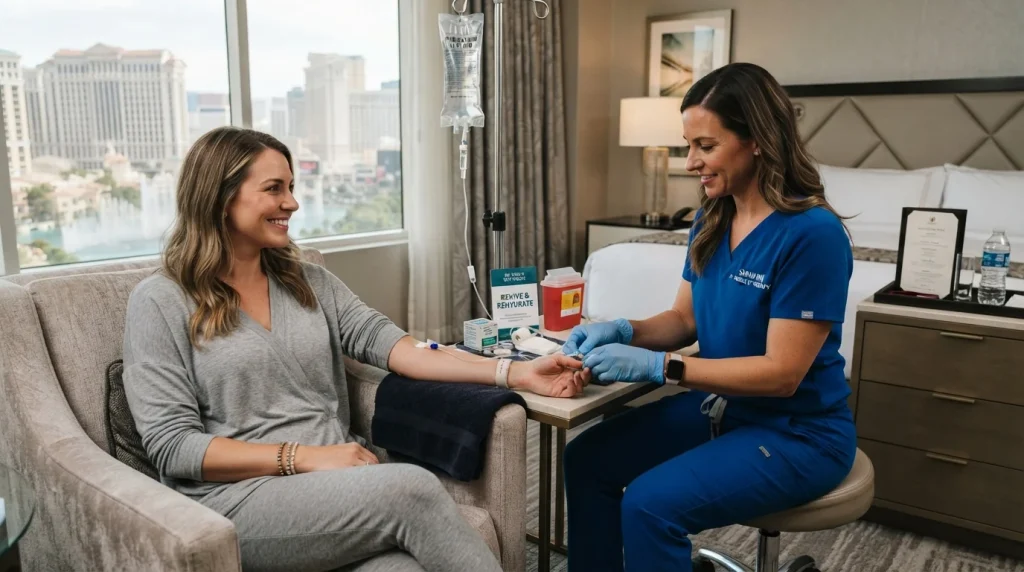
A mobile IV looks like a delivery, but it runs like a prescription. Your part is two things: giving straight answers before it starts, and watching the spot where the IV went in afterwards. Before any of that, you pick the drip: the menu of every drip and shot we offer is where you compare them and book one.
Key things to know
- You don't need a prescription of your own, but every drip still runs on an order from a licensed prescriber.
- Giving the IV and ordering it are separate jobs, so the nurse or REMT at your door may not be the nurse practitioner who wrote your order.
- Booking takes a $50 deposit, which comes off your total. A visit between 8 p.m. and 7 a.m. carries a $99 after-hours fee.
- Have your medicines and allergies written down before the visit. They're checked against what's going into the bag.
- For 24 hours afterwards, keep an eye on the spot where the IV went in. If your drip included Benadryl, don't drive until you know how it affects you.
Do you need a prescription for a mobile IV?
Not one of your own. Booking a drip asks for a treatment, a time and a $50 deposit, not a prescription. The drip is still prescribed, though. In Nevada, a registered nurse giving IV fluids outside a hospital needs an order from a licensed practitioner who assessed the patient before writing it, and has to check that nothing documented or reported conflicts with what was ordered (Nevada State Board of Nursing).
Here, the order comes from Rich Majors, FNP-BC, a family nurse practitioner with prescriptive authority. The service as a whole runs under the medical oversight of our Medical Director, Dr. Daniel Olivero, MD.
Some drips carry medicines on top of the fluids. The Hangover IV includes Toradol and Zofran, and the Migraine Relief IV includes Toradol, Zofran and Benadryl, all prescription medicines. The Omega adds two medications of choice. That's why you'll be asked about your medicines and allergies: they're checked against what's going into the bag.
Before your IV: booking and what to have ready
While you wait, write down the medicines you take and any allergies. Pick a spot where you can sit comfortably for the length of the drip, and wear something with a sleeve that pushes up past the elbow.
At the door and during the drip
The person who arrives is one of the team's licensed nurses or REMTs (nationally registered emergency medical technicians). It may not be the nurse practitioner who wrote your order. Giving the IV and ordering it are separate jobs.
The questions come first. Expect to go over your health, including any medicines and allergies.
Then the IV. A small, soft plastic tube goes into a vein, usually in your hand or arm. You may feel brief discomfort as the needle goes in, and it stops once the needle is withdrawn, leaving only the soft tube in the vein (NHS patient information). From there, the drip runs for the rest of the visit.
After the IV comes out
When the bag is finished, the tube comes out.
Benadryl changes what you can do afterwards. It's part of the Migraine Relief IV, and it can make you drowsy. If your drip included it, don't drive until you know how it affects you, and MedlinePlus advises avoiding alcohol while you're taking it, since alcohol adds to the drowsiness.
Sources and references
- Nevada State Board of Nursing. Practice Decision: RN Scope in Out of Hospital Administration of IV Solutions and Medications. Approved November 18, 2020.
- Gloucestershire Hospitals NHS Foundation Trust. Peripheral intravenous (IV) cannula. Patient information GHPI0935_07_25.
- MedlinePlus, U.S. National Library of Medicine. Diphenhydramine. Revised March 15, 2026.