Is peptide therapy safe? The honest answer is that it depends far less on the molecule than on two things most marketing skips: where the peptide came from, and who is supervising you while you use it. Nearly every peptide sold in a wellness setting today is compounded, which means it is not an FDA-approved drug.
That is not the same as saying it is illegal, and not the same as saying it is fine. This guide covers where the FDA stands as of August 2026, the risk categories worth understanding, and seven questions to ask any provider first. If you are researching a specific compound, our page on sermorelin therapy in Las Vegas covers that service directly. This article is general information, not medical advice.
- Key things to know
- What compounded peptide actually means
- Where the FDA stands on peptides in 2026
- The real risks, by category
- Who should not start peptide therapy
- What medical oversight should look like
- 7 questions to ask before you start
- Three things people get wrong
- When to stop and call a provider
- Common questions
Key things to know
- Compounded peptides are not FDA-approved drugs. Compounding and approval are different regulatory routes.
- In July 2026 an FDA advisory committee recommended six peptides for the list compounding pharmacies may draw from. A recommendation is not an approval, and the rulemaking that would make it binding is still pending.
- The FDA's stated concerns are about manufacturing: peptide-related impurities, active ingredient characterization, aggregation, and immunogenicity depending on the route.
- Human safety data on most of these compounds is thin. Long-term outcome data is thinner still.
- A peptide prescribed after a good-faith exam by a provider who knows your medications is a different product, legally and practically, from a vial sold online under a research label.
What compounded peptide actually means
A compounded medication is prepared for a specific patient by a licensed pharmacy, rather than manufactured in fixed doses under an FDA approval. Compounding is a long-standing, lawful part of medicine.
These statements have not been evaluated by the FDA. Compounded peptides are not FDA-approved products, and this service is not intended to diagnose, treat, cure, or prevent any disease.
Compounded is not the same as FDA-approved
FDA approval means the agency reviewed clinical trial data and concluded a drug is safe and effective for a named use. Compounded preparations do not go through that review. As Johns Hopkins Bloomberg School of Public Health notes in its explainer on how the FDA regulates peptides, some peptides such as insulin and the branded GLP-1 drugs are approved after exactly that kind of study, while many others in circulation have limited evidence behind them.
This is the same framing we apply to investigational treatments like stem cell therapy. A treatment can be lawfully offered and still be investigational.
Prescribed by a provider versus bought online
This distinction matters most, and almost nobody draws it. Much of what people call peptide therapy is a vial from an online seller, labeled for research use and not for human consumption. Those products are not prescription medication. Nobody reviewed your medical history, nobody verified the contents, and nobody is accountable if something goes wrong.
A prescribed compounded peptide requires a medical evaluation, a prescriber with authority to write it, and a pharmacy that answers to a regulator. The molecule on the label may be identical. The safety system around it is not.
Where the FDA stands on peptides in 2026
The regulatory picture moved in 2026, and most content online has not caught up. Here is the state as of August 2026.
The 503A bulks list and its three categories
Section 503A of the Federal Food, Drug, and Cosmetic Act governs which bulk drug substances a compounding pharmacy may use. Nominated substances are sorted into three groups. Per the FDA's page on bulk drug substances used in compounding under section 503A, Category 1 substances may be eligible and the agency does not intend to act against compounders using them under stated conditions. Category 2 covers substances where the agency "has identified significant safety risks" pending further evaluation. Category 3 covers substances nominated with insufficient information to evaluate.
Most peptides marketed for wellness have spent time in Category 2 or Category 3.
What the July 2026 advisory committee vote changed
On 23 and 24 July 2026 the FDA's Pharmacy Compounding Advisory Committee reviewed nominated peptides for the 503A bulks list and recommended six: BPC-157, KPV, TB-500, MOTS-c, Epitalon, and Semax. Per AJMC's report on the meeting, the votes were close, at 8 to 6 for BPC-157, KPV, and TB-500, 7 to 5 for MOTS-c, 7 to 4 for Epitalon, and 8 to 5 for Semax. A seventh, emideltide, was rejected. The FDA meeting record documents the session.
The FDA's briefing document laid out the agency's technical concerns: peptide-related impurities, difficulty characterizing the active ingredient, potential for aggregation, and immunogenicity risk that varies by route.
Why a recommendation is not an approval
An advisory committee recommendation is not binding. Before any of those six has unambiguous standing for compounding, the agency must complete notice-and-comment rulemaking, which typically runs 8 to 12 months. Nothing about the July vote made any peptide FDA-approved. Approval for a therapeutic use is a separate route, and none of the six has it.
The real risks, by category
Risk with peptides clusters into four areas. None is exotic. Each is manageable or unmanageable depending on the source and the supervision.
Purity, potency, and sourcing
This is the FDA's leading concern and it should be yours. A peptide is a chain of amino acids, and small errors in synthesis leave behind impurities that are hard to detect and hard to characterize. Peptides can also aggregate, meaning the molecules clump, which changes how the body responds. When you cannot verify what is in the vial, you cannot reason about the risk at all.
Injection-site and administration risk
Most peptides are given by subcutaneous injection, which carries the ordinary risks of any injection: redness, soreness, bruising, swelling, and infection if sterile technique fails. Storage matters too, since a peptide handled incorrectly can degrade before use. Learning the technique from a licensed professional rather than a video is the difference here.
Drug interactions and existing conditions
Compounds acting on appetite, blood sugar, hormone signaling, or blood pressure can interact with medication you already take. Sorting that out requires someone holding your full medication list. This is where a missing medical exam stops being a paperwork gap and becomes a safety problem.
The long-term data gap
For most of these compounds, long-term human outcome data does not exist. Preclinical work and small case series are not years of controlled follow-up. Anyone describing an established long-term safety profile is describing a study that has not been done.
What medical oversight should look like
Regulatory status tells you what a peptide is. Oversight tells you whether the situation around it is safe.
The good-faith exam
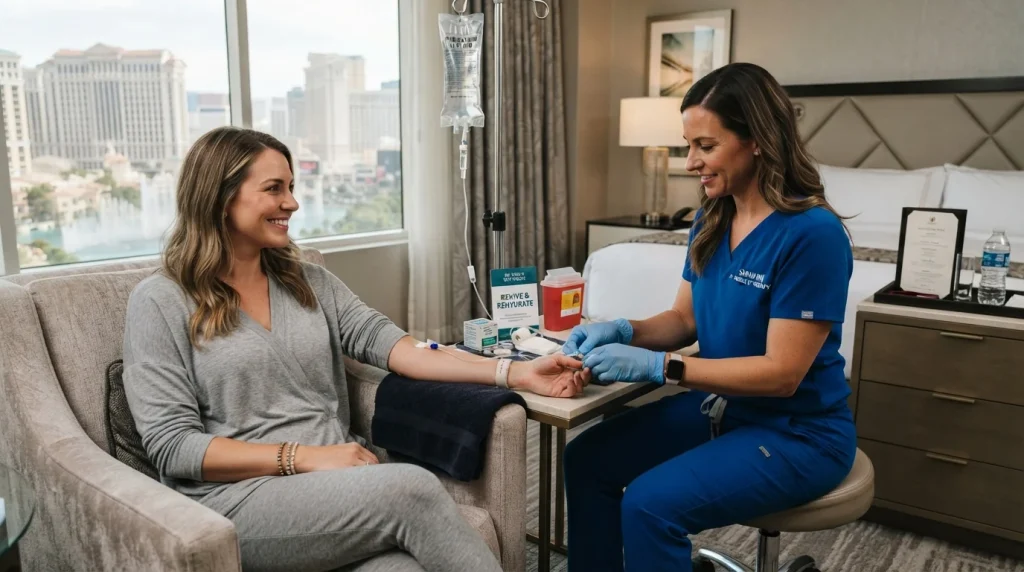
A good-faith exam is a medical evaluation, not a checkout step. A provider reviews your health history, current medications, and reason for asking, then decides whether a prescription is appropriate and can decline. At Las Vegas Mobile IV Therapy, peptide therapy is gated behind a good-faith exam and provider approval, and the first dose is administered by a licensed medical professional who shows you how to continue safely at home.
If a provider will sell you a peptide without that step, the gate that protects you is missing. That is worth more attention than the price.
Who is allowed to prescribe, and who administers
Three roles get conflated constantly, and separating them tells you a lot about a practice. The ordering provider holds prescriptive authority and writes the prescription. Here that is Rich Majors, FNP-BC, a board-certified Family Nurse Practitioner. Medical direction over care protocols sits with Medical Director Dr. Daniel Olivero, MD. Administration is carried out by licensed nurses and NREMTs, and scope differs by credential, so not every practitioner offers every treatment.
The content on this page is separately reviewed by a physician, a fourth and distinct role. Ask any provider to name these people.
7 questions to ask before you start
Use these on any provider, including this one. The answers, and how readily they come, tell you most of what you need.
- Is this peptide FDA-approved for what I am asking about? For nearly every peptide the honest answer is no. A provider who says yes is either mistaken or selling.
- Which pharmacy compounds it, and can you name them? A licensed compounding pharmacy has a name, a state, and a regulator. Vagueness here is the biggest red flag.
- Who is the prescribing provider, and will I be examined first? You want a named person with prescriptive authority and a real good-faith exam, not an online form.
- What are you doing with my full medication list? If nobody asks for it, nobody is checking for interactions.
- Who administers the first dose, and what are their credentials? Learning injection technique from a licensed professional in person reduces the risk no vial label can address.
- What are the known side effects, and what should make me stop? A provider who cannot describe adverse effects clearly has not thought about them.
- What does this cost in total, and what am I getting? A single in-visit injection, a take-home supply, and a telehealth visit are three different purchases. For how we handle cost transparency, see our Las Vegas IV therapy pricing guide.
Three things people get wrong
Myth: if a clinic sells it, the FDA approved it
Selling and approval are unrelated. Compounded preparations are lawfully dispensed without FDA approval, and a clinic offering a peptide tells you nothing about the agency's position. As of August 2026, no peptide reviewed at the July meeting is FDA-approved for a therapeutic use.
Myth: compounded semaglutide is just a generic version of the branded drug
It is not. Compounded semaglutide is not the FDA-approved branded product, and it is not a generic, which is a specific regulatory category with its own approval pathway. The FDA has issued warning letters to sellers marketing compounded GLP-1 products with claims implying equivalence, stating plainly that compounded drug products are not FDA-approved. Our semaglutide service page describes what is actually offered.
Myth: a research-use vial is the same product for less money
A vial labeled for research use and not for human consumption is not prescription medication and was never intended for a person. Nobody verified its contents against a prescription, nobody reviewed your history, and no licensed pharmacy stands behind it.
When to stop and call a provider
Stop and seek care promptly if you notice spreading redness, warmth, swelling, or drainage at an injection site, or a fever after injecting. Those are signs of possible infection and they do not resolve by waiting.
Call 911 or go to the nearest emergency room for trouble breathing, swelling of the face, lips, or throat, hives spreading across the body, chest pain, fainting, or a severe rapid change in how you feel after a dose. Those are signs of a serious allergic or systemic reaction and they are emergencies.
Contact your prescribing provider for persistent nausea, vomiting, dizziness, unusual fatigue, or any new symptom that does not settle within a day or two. Peptide therapy is elective care, not emergency care. Individual results vary.
Sources and References
- U.S. Food and Drug Administration. Bulk Drug Substances Used in Compounding Under Section 503A of the FD&C Act.
- U.S. Food and Drug Administration. July 23-24, 2026: Meeting of the Pharmacy Compounding Advisory Committee.
- U.S. Food and Drug Administration. FDA Briefing Document, Pharmacy Compounding Advisory Committee Meeting, 2026.
- American Journal of Managed Care. FDA Panel Backs 6 Peptides for Compounding, 2026.
- Johns Hopkins Bloomberg School of Public Health. How the FDA Regulates Peptides, 2026.
- U.S. Food and Drug Administration. Warning Letter, GLP-1 Solution, 2025.
Service Area
Las Vegas Mobile IV Therapy serves the Las Vegas metro and Southern Nevada, 24 hours a day. To reach a provider, call (725) 217-4236.