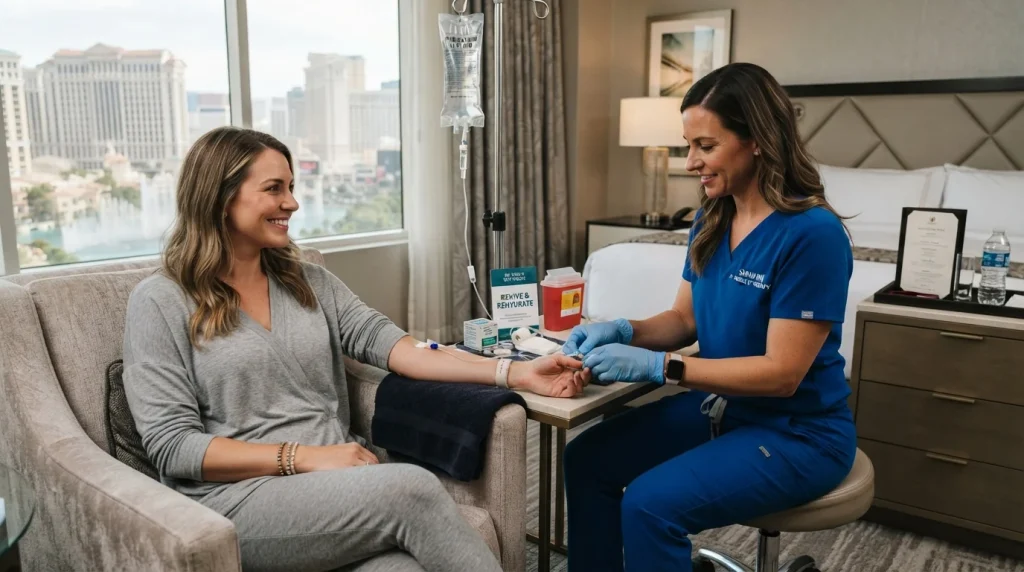
Liquid IV and a Hydration drip from Las Vegas Mobile IV Therapy both get water and sodium into your blood. The drip costs $199 and takes roughly an hour and a half to two hours from booking to the end of the bag. What separates them is the route, and while your stomach keeps fluid down, the evidence says the drink is the place to start.
- Why a drink with salt and sugar does the job
- What's in each, liter for liter
- Plain water and IV fluid
- Sports drinks carry more sugar and less salt
- Does Liquid IV help when you're sick?
- Signs that drinking isn't keeping up
- A liter by mouth or by vein: the cost and the clock
- Common questions about Liquid IV and IV fluid
Why a drink with salt and sugar does the job
Your small intestine absorbs sodium and glucose together, and water follows them across the gut wall; the CDC's guidance on stomach bugs calls this coupled transport. That's why rehydration drinks carry both salt and sugar.
It holds up against IV fluids, too. A Cochrane review of the trials comparing the two in children with stomach bugs found no clinically important difference between rehydrating by mouth and by vein; for every 25 children rehydrated by mouth, one didn't manage and needed an IV. For adults and children with acute diarrhea, the Infectious Diseases Society of America's 2017 guideline makes a reduced-osmolarity oral rehydration solution, such as the formula from the World Health Organization (WHO), the first choice for mild to moderate dehydration, vomiting included. It keeps IV fluids such as normal saline for oral rehydration that has failed, and for severe dehydration, shock or confusion. Those last three need an emergency room, not a drip at home.
Despite its name, Liquid IV never touches a vein. It's a powder you stir into water, built on that same idea. Its maker classes it as an oral rehydration solution and also says it isn't a medical product: it was made for active people who struggle to stay hydrated day to day. It isn't made to the WHO recipe, though. Mixed as directed, one stick in 16 ounces of water, it carries less sodium and more sugar per liter than the WHO formula.
So a drink is enough when you can get it down and keep it down. A hot afternoon on the Strip, a hard workout, the first day of a cold, the morning after a late night: an electrolyte drink covers all of those. If you've just landed, recovering after a long flight takes more than choosing between a drink and a drip.
What's in each, liter for liter
Every option below is water plus some sodium. They differ in how much, in how much sugar comes with it, and in the route.
| Per liter | Route | Sodium | Sugar |
|---|---|---|---|
| Las Vegas tap water | By mouth | About 89 mg (4 mmol) | None |
| Gatorade Thirst Quencher, a sports drink | By mouth | About 460 mg (20 mmol) | About 59 g (sugar and dextrose) |
| Liquid IV, 1 stick in 16 oz | By mouth | About 1,060 mg (46 mmol) | About 23 g |
| WHO oral rehydration solution | By mouth | About 1,725 mg (75 mmol) | 13.5 g (glucose) |
| The Hydration drip: normal saline with vitamin C, B-complex and B12 | Into a vein | About 3,540 mg (154 mmol) | None |
Both the stick and the bag list vitamin C and B12, so the vitamin list isn't what separates them; the route and the full liter are. The WHO formula is also deliberately weaker than the bag. Its lower-salt, lower-sugar version replaced an older, stronger recipe after trials found children given it needed fewer unplanned IV drips, as both the CDC and the WHO and UNICEF's 2004 statement report. A vein, by contrast, takes saline close to the concentration of blood.
Plain water and IV fluid
When plain water is enough
For everyday thirst, plain water is the right drink. It's all most people need on most days. Las Vegas tap water carries about 89 mg of sodium per liter, according to the Las Vegas Valley Water District's 2026 summary, roughly a twelfth of what a liter of Liquid IV carries. After you've lost salt along with water, through a long sweat in triple-digit heat or through vomiting and diarrhea, a drink with sodium and a little sugar puts back what plain water doesn't.
What makes IV fluid different from drinking water
The fluid in an IV bag isn't plain water. In the Hydration drip it's a liter of normal saline: sterile water with 0.9 percent sodium chloride, 154 millimoles of sodium per liter, close in concentration to your blood plasma. That match is what lets it run straight into a vein. Plain water can't be given that way. The FDA label for sterile water warns that putting it into a vein with nothing dissolved in it can burst red blood cells. Water you drink never meets your blood directly; your intestine absorbs it, and your body balances the salt as it goes.
Sports drinks carry more sugar and less salt
Sports drinks are made for exercise. Per liter, Gatorade Thirst Quencher works out to about 59 g of carbohydrate and about 460 mg of sodium, from its maker's own figures: roughly four times the sugar of the WHO formula and about a quarter of its sodium. For children's stomach bugs, the CDC recommends an oral rehydration solution and advises against large amounts of soda, juice and other sugary drinks, because the sugar load might make diarrhea worse. It says nothing about sports drinks. On both sugar and sodium, they sit between juice and a rehydration solution. Against a drip, the choice works the way it does for Liquid IV: while a sports drink stays down, it's the cheaper liter. If it won't stay down, the signs below apply.
Does Liquid IV help when you're sick?
Yes, as long as it stays down. A fever, vomiting or diarrhea all raise the fluid you lose, and feeling ill often makes you drink less, so an electrolyte drink is an easy way to keep up. Nothing in a stick treats the illness itself. What it replaces is fluid and salt.
With a stomach bug, go slowly. The CDC's guidance for children who are vomiting uses small amounts often, about a teaspoon (5 mL) of rehydration solution every 5 minutes, rather than a full glass, and it reports that most vomiting children can be rehydrated this way. Liquid IV is a closer match to the WHO formula than a sports drink is, with more sodium and less sugar per liter, but it isn't the formula.
If even those small sips keep coming back up, drinking has stopped helping. For a child, that is the point to call their doctor: the CDC lists vomiting that won't settle, too little taken in, and rehydration that isn't working among the reasons a child may need hospital care. For an adult, the next section covers what to do.
Signs that drinking isn't keeping up
Drinking has stopped working when either of these is true:
- What you drink comes back up, even in small sips taken a few minutes apart.
- You're losing fluid through vomiting or diarrhea faster than you can sip it back.
At that point the choice is no longer between a drink and a drip at home. Cleveland Clinic says moderate dehydration needs IV fluids given in an urgent care, emergency room or hospital, and MedlinePlus notes that a provider will also treat the cause of the dehydration, not just the fluid loss. For a child, call their doctor. For an adult, call your doctor or go to an urgent care.
Signs of severe dehydration or heatstroke are more urgent still, and they mean an emergency room or 911. Between them, MedlinePlus and Cleveland Clinic list:
- confusion or any other change in alertness
- dizziness or lightheadedness
- fainting or loss of consciousness
- a seizure
- a rapid heartbeat or rapid breathing
- no urine, or very dark urine
- a fever over 102°F
- heatstroke signs such as red, hot, dry skin
If any of those appear, or you're getting worse despite treatment, that's emergency care.
A liter by mouth or by vein: the cost and the clock
Compare a liter with a liter. Two sticks of Liquid IV, each mixed into 16 ounces of water, make close to a liter of rehydration drink for about $3 at the maker's one-time list price. The Hydration drip's liter, with its vitamins, costs $199. If fluid is all you want, the IV Fluids bag is a liter for $150. A $99 after-hours fee applies to visits between 8 PM and 7 AM. The $50 deposit you pay when you book comes off the total; it isn't added to it.
Then the clock. A licensed nurse or NREMT typically arrives 45 to 60 minutes after you book, fastest on the Strip and Downtown and a little longer in Henderson and Summerlin, and up to 90 minutes on weekend mornings, holidays and convention weeks. Before the IV is started, the clinician checks your vitals and reviews your health history, current medications and allergies. The Hydration visit itself takes 45 minutes, and the IV Fluids visit 35. From booking to the end of the bag, plan on roughly an hour and a half to two hours, longer at busy times. A drink you can keep down, you can start right now.
So while drinks stay down, the liter by mouth is cheaper and sooner, and the evidence above doesn't show a drip doing more for someone who can keep fluid down. Some adults choose the drip anyway: a liter given while they rest at home or in a hotel room, with vitamins in the bag. That's a fair reason to book one when none of the warning signs above apply. Once drinks stop staying down, the comparison is no longer about price; it's the point to be seen, as the section above explains.
Common questions about Liquid IV and IV fluid
Sources and References
- Hartling L, et al. Oral versus intravenous rehydration for treating dehydration due to gastroenteritis in children. Cochrane Database of Systematic Reviews, 2006, CD004390. https://pubmed.ncbi.nlm.nih.gov/16856044/
- Shane AL, et al. 2017 Infectious Diseases Society of America Clinical Practice Guidelines for the Diagnosis and Management of Infectious Diarrhea. Clinical Infectious Diseases, 2017, 65(12). https://pmc.ncbi.nlm.nih.gov/articles/PMC5850553/
- Centers for Disease Control and Prevention. Managing Acute Gastroenteritis Among Children: Oral Rehydration, Maintenance, and Nutritional Therapy. MMWR, 2003, 52(RR-16). https://www.cdc.gov/mmwr/preview/mmwrhtml/rr5216a1.htm
- World Health Organization and UNICEF. Joint Statement: Clinical Management of Acute Diarrhoea. 2004. https://iris.who.int/bitstream/handle/10665/68627/WHO_FCH_CAH_04.7.pdf
- StatPearls. Normal Saline. NCBI Bookshelf, updated April 26, 2025. https://www.ncbi.nlm.nih.gov/books/NBK545210/
- DailyMed, U.S. National Library of Medicine. Sterile Water for Injection, prescribing information. https://dailymed.nlm.nih.gov/dailymed/drugInfo.cfm?setid=3a6422e1-feee-4095-8883-2b0837039e6e
- MedlinePlus. Dehydration. Reviewed July 1, 2025. https://medlineplus.gov/ency/article/000982.htm
- Cleveland Clinic. Dehydration. Updated June 5, 2023. https://my.clevelandclinic.org/health/treatments/9013-dehydration
- Cleveland Clinic. IV Vitamin Therapy: Does It Work? March 9, 2026. https://health.clevelandclinic.org/iv-vitamin-therapy
- Las Vegas Valley Water District. 2026 Water Quality Summary. https://www.lvvwd.com/assets/pdf/water-quality-summary-las-vegas-valley.pdf
- Liquid I.V. Hydration Multiplier, Lemon Lime: nutrition facts, ingredients, directions and price, FAQ and the origins of Liquid I.V. Read October 13 and 14, 2026. https://www.liquid-iv.com/products/lemon-lime-hydration-multiplier
- Gatorade. Thirst Quencher, sodium per 20 oz serving and carbohydrate per 12 oz serving. Read October 13, 2026. https://performancepartner.gatorade.com/products
Service area
Visits cover the Las Vegas metro and Southern Nevada, including:
- Las Vegas
- Henderson
- North Las Vegas
- Summerlin South
- Paradise
- Enterprise
- Sunrise Manor
- Winchester
- Whitney
- Boulder City
- Mesquite
- Laughlin
- Pahrump
- Primm
- Moapa Valley
- Searchlight
- Lake Las Vegas