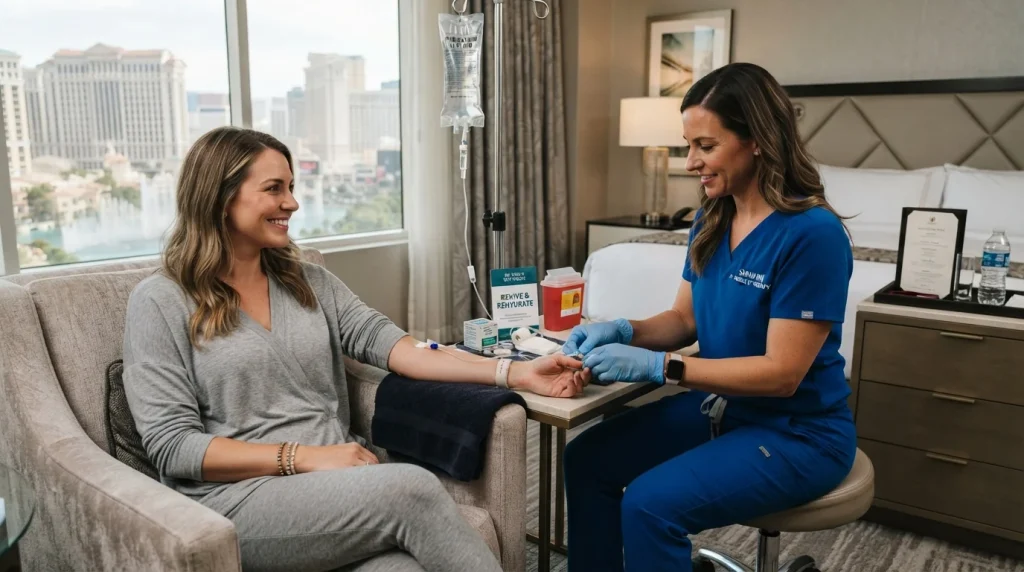
Peptide therapy is a medical treatment that uses peptides, short chains of amino acids that act as signals in the body, prescribed and compounded for one person at a time. This plain-English guide explains what peptides are, how the therapy is delivered at home in Las Vegas, where it stands with the FDA, and who should talk to a provider before starting.
Key things to know about peptide therapy
- Peptides are short chains of amino acids, typically 2 to 50, that work as signaling molecules. They are not a fuel, a vitamin, or a steroid.
- Peptide therapy here is a compounded, prescription medication made for one patient. It is not a product you buy off a shelf or order as a powder online.
- Most peptides used this way are not FDA-approved for the uses people ask about, and compounded semaglutide or tirzepatide are not the branded, FDA-approved products.
- The vial is left with you, and a nurse teaches you how to draw it up and self-administer it. Rich Majors, FNP-BC, is the ordering provider who writes the prescription.
- Peptide therapy is not right for everyone. Some people should talk to a provider before starting, and a provider decides whether it is appropriate for you.
What peptides actually are
Before you can judge whether peptide therapy makes sense for you, it helps to know what a peptide is. The word gets used loosely in wellness marketing, but the underlying chemistry is simple and well defined.
Peptides are short chains of amino acids
A peptide is a short chain of amino acids, typically 2 to 50, linked together by peptide bonds (National Human Genome Research Institute). Amino acids are the same building blocks that make up proteins. A longer chain, 51 amino acids or more, is called a polypeptide, and longer still is a protein. The shorter length is what separates a peptide from a protein.
Peptides work as signals, not fuel
Peptides act as signaling molecules. Many of them bind to receptors on cells the way a key fits a lock, which tells the cell to do something specific (National Library of Medicine). That is a different job from a nutrient or a fluid. A peptide does not hydrate you or feed you. It carries a message.
Naturally occurring versus compounded peptides
Your body already makes many peptides on its own. Insulin, for example, is a peptide hormone. Peptide therapy uses lab-made versions of these signals, prepared by a compounding pharmacy into a medication a provider prescribes. So the category is not exotic. What changes with therapy is that a specific peptide is compounded, prescribed, and dosed under medical direction rather than produced by your own body.
How peptide therapy is delivered in Las Vegas
The part that sets one peptide provider apart from another is not the molecule list. It is how the therapy actually reaches you and who supports you through it. Here, the model is built around a patient-specific vial and hands-on nurse education.
A patient-specific compounded vial, left with you
Each peptide is dispensed as a patient-specific vial that is left with you. It is compounded for you based on what the ordering provider prescribes, not drawn from a shared multi-dose supply. That is the difference between a prescribed, patient-specific medication and a generic product handed out the same way to everyone.
A nurse teaches you to self-administer
A licensed nurse provides education on dosing, drawing up the vial, and self-administration, so you are not left to figure it out from a video. The ordering provider is Rich Majors, FNP-BC, a board-certified Family Nurse Practitioner who holds prescriptive authority for the Las Vegas team. You can review our mobile IV and injection services to see how the in-home model works across treatments.
How supply and cadence work
Most peptides are dispensed as a one-month supply. Two are different: semaglutide therapy in Las Vegas and tirzepatide are dispensed as an 8 to 10 week supply. Your provider sets the plan that fits what was prescribed, and the nurse walks you through it before you start.
How peptides are grouped
The Las Vegas menu spans more than two dozen compounded peptides, priced from $75 to $399, and providers usually organize them by the goal a person is asking about. The groups below are how the menu is arranged and how people search, not a claim about what any single peptide does. Naming a category is not a promise that a peptide delivers that result. Whether a specific peptide is appropriate for you, and what it may or may not do, is a medical decision your provider makes with you.
Metabolic and weight-related peptides
This is the category people ask about most when weight or metabolism is the reason they called. It includes semaglutide and tirzepatide, along with AOD-9604, MOTS-c, Lipo-C, and tesamorelin. If this is your goal, the honest first step is a provider conversation, and you can read more about our weight-management support options.
Recovery and tissue peptides
This group is the one people ask about for recovery reasons. It includes BPC-157 and TB-500, along with blend formulas the pharmacy compounds, such as Wolverine, Klow, and KPV.
Energy, longevity, and other categories
Other groups on the menu cover energy and longevity, with peptides such as NAD+ injections, SS-31, and Epitalon; skin, with GHK-Cu and the Glow blend; growth-hormone support, with sermorelin therapy and CJC-1295 with Ipamorelin; sexual health, with PT-141 and Kisspeptin; and focus or calm, with Semax and Selank. Each name is a starting point for a conversation, not a recommendation.
Are peptides FDA-approved?
This is the question most peptide pages skip, and it is the one that matters most for a medical decision. The honest answer is that most peptide therapies are compounded and are not FDA-approved for the uses people ask about.
Most peptide therapies are compounded, not FDA-approved
Compounding is a separate, legal pathway from FDA drug approval. A compounding pharmacy prepares a medication for a specific patient, but compounded drug products are not FDA-approved, and the FDA advises that they be used only when a patient's needs cannot be met by an FDA-approved drug (U.S. Food and Drug Administration). That means most peptides on a therapy menu are used in an investigational way, without the FDA review for safety, effectiveness, and quality that an approved drug goes through.
Compounded semaglutide and tirzepatide are not the branded products
Compounded semaglutide and tirzepatide are not the same as the branded, FDA-approved medications people have heard of. The FDA has warned that unapproved, compounded versions of these GLP-1 drugs do not undergo its review, and it has flagged fraudulent and mislabeled products in the market (U.S. Food and Drug Administration). If a provider prescribes a compounded version, it should be presented as exactly that, not as the brand-name shot.
Why sourcing and oversight matter
The biggest safety difference in peptide therapy is not the peptide. It is where it came from and who is watching. A prescribed, compounded peptide comes with a provider who reviews your history, a pharmacy that prepares it, and a nurse who teaches you how to use it. Peptides sold online as research-use powders come with none of that. The FDA has flagged fraudulent and mislabeled compounded semaglutide products, including labels naming pharmacies that do not exist, and has received reports of dosing errors from people measuring their own doses (U.S. Food and Drug Administration). That is the gap medical oversight is meant to close.
Common myths about peptide therapy
Myth: peptides are the same as anabolic steroids
Reality: peptides are short chains of amino acids that act as signals, a different chemical class from anabolic steroids (National Human Genome Research Institute). Grouping every performance-related compound as a steroid is inaccurate.
Myth: compounded semaglutide is just a cheaper version of the brand-name shot
Reality: a compounded version is not FDA-approved and is not the branded, FDA-approved product, which the FDA has warned about directly (U.S. Food and Drug Administration). Same active ingredient name does not mean same product, same review, or same oversight.
Myth: ordering research peptides online is the same as a clinic protocol
Reality: online research-use powders come with no prescription, no provider reviewing your health, and no guarantee of what is in the vial. A prescribed protocol is the opposite on all three counts.
When to talk to a provider about peptide therapy
Because peptide therapy is a prescription medication, the decision to start is a medical one, not a purchase. A short consult is where that decision is made.
What a peptide consult covers
The provider reviews your health history, your current medications, and what you are hoping to address. From there, the provider decides whether peptide therapy is appropriate and writes a prescription only if it is. This is also where the practice's medical direction matters, under Medical Director Dr. Daniel Olivero, MD, who oversees care protocols.
What to expect if you start
If peptide therapy is prescribed, your patient-specific vial is compounded and left with you, and a nurse teaches you how to draw it up and self-administer it. You are not sent home to guess. To ask a question or start a consult, call or book online, and the team will confirm next steps across the Las Vegas metro.
Sources and references
- National Human Genome Research Institute. Peptide (Genetics Glossary).
- National Library of Medicine, StatPearls. Biochemistry, Peptide.
- U.S. Food and Drug Administration. Compounding and the FDA: Questions and Answers.
- U.S. Food and Drug Administration. FDA's Concerns with Unapproved GLP-1 Drugs Used for Weight Loss.