On our menu, a liter of IV fluid costs $150. The same liter with vitamins added costs $199, $225 or $299, depending on the drip. So the real question behind "do vitamin drips work" is what that extra $49 to $149 buys. The answer is narrower than the usual pitch, and it depends more on you than on what's in the bag.
- The same liter, four prices
- What IV changes for vitamin C, and for how long
- What happened when trials tested the vitamins
- Is a drip better than vitamins by mouth?
- Side effects, and who should skip a vitamin drip
- Should you get a vitamin drip before a trip?
- The pros and cons, and when a drip makes sense
- Other questions about vitamin drips
- Sources and References
The same liter, four prices
That's $49, $75 or $149 for the vitamins, plus ten minutes. Only the Mega Myers' amounts are given here. The Hydration and the Myers' Cocktail IV carry vitamin C too, so ask if the amount matters to you.
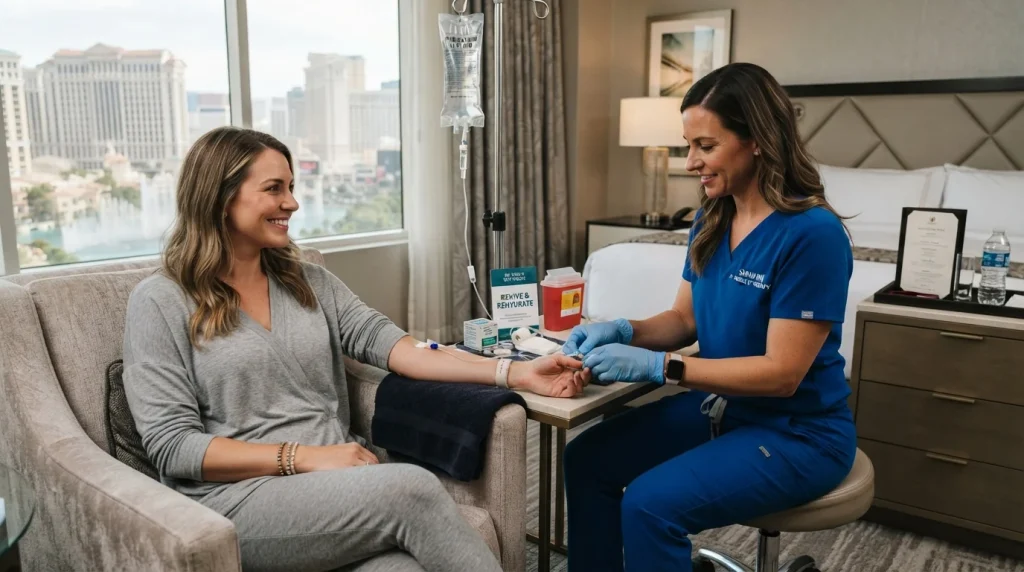
Whether the liter itself does you any good is its own question. Everything below is about the vitamins. Whichever drip you choose, one of our licensed nurses or REMTs gives it, at home or in your hotel room.
What IV changes for vitamin C, and for how long
Your gut rations vitamin C. Take more by mouth and your blood level still stays inside a tight band. A drip bypasses digestion entirely, and that's where the difference shows. In a 2004 study of 17 healthy volunteers, the same 1.25 g dose peaked about six and a half times higher in the blood when given by IV (885 against 135 micromoles per liter). Even the largest dose people tolerate by mouth, taken every four hours, was predicted to top out around 220 micromoles per liter.
The peak doesn't last. Once your blood level passes what the kidneys hold onto, most of the excess leaves in urine. In two studies of high-dose IV vitamin C in people with cancer, half of it was gone about every two hours. The label of an FDA-approved vitamin C injection reports a slower rate after a 1 g dose: about seven hours, measured in three people. Even at that pace, about 1 percent of the extra would be left two days after a drip.
That short, high peak is the measurable thing a vitamin drip does. One of the two-hour studies included a 5 g dose, the amount in a Mega Myers, and found the same rate as at 60 g.
What happened when trials tested the vitamins
Two trials that set the vitamins against plain fluid found a difference only in people whose vitamin C started low. A higher blood level is only worth paying for if it changes something.
The first tested a Myers' cocktail. In 2009, 34 adults with fibromyalgia got either the vitamin drip or a bag of lactated Ringer's, a plain IV fluid, once a week for eight weeks, and neither they nor the researchers knew which. Both groups improved. No outcome, from tender points to pain to mood, differed significantly between them, and the authors put that partly down to how much the placebo group improved.
The second gave 141 office workers aged 20 to 49 either 10 g of vitamin C in saline or the saline alone. The vitamin C group reported less fatigue two hours later and again the next day. But the difference held only for people whose vitamin C was low to begin with. Among those who started higher, it wasn't significant.
If your levels are normal, the good feeling after a drip is hard to separate from the fluid and the visit itself, which is what the placebo group in the first trial got. Both trials were small. The first was in people with a chronic pain condition, and the second used twice the vitamin C in a Mega Myers.
Is a drip better than vitamins by mouth?
For vitamin C, only in one narrow sense: a drip reaches blood levels no pill can, for a few hours. For B12, the comparison that has been tested is pills against injections. Pills held their own. A 2018 Cochrane review found that people short of B12 who took 1,000 micrograms a day by mouth raised their blood levels about as well as people given injections, at lower cost. It rated the evidence low quality, from three small trials.
A drip has a real edge when your gut can't do the job. You can't keep food or pills down, you can't drink enough, or you don't absorb well. That's the situation an FDA-approved vitamin C injection is meant for: its label covers treating scurvy, for up to a week, in people who can't take vitamin C by mouth. If none of that describes you, pills cost less. Within a day or two, your blood level is back where your body keeps it either way.
Side effects, and who should skip a vitamin drip
The usual side effect is where the needle goes in. The vitamin C injection's label lists pain and swelling at the infusion site as its most common reactions, and Cleveland Clinic adds bruising and infection at the needle site.
The bigger question is whether you're one of the people the evidence singles out. The label and Cleveland Clinic name these:
- G6PD deficiency. In people with this inherited enzyme deficiency, vitamin C can break down red blood cells, sometimes severely. The label says not to go above the daily allowance.
- Pregnancy or breastfeeding. The same limit applies: no more than the daily allowance, which is 85 mg in pregnancy and 120 mg while breastfeeding. A Mega Myers holds 5,000 mg.
- Kidney disease, a history of oxalate kidney stones, or older age. Kidney injury from oxalate has been reported after high doses of vitamin C given over a long period, and the label puts these groups at higher risk.
- Diabetes, if you check your sugar. Vitamin C can throw off blood and urine glucose readings for up to 24 hours after an infusion, according to the label.
- Heart disease or high blood pressure. Cleveland Clinic advises avoiding IV vitamin therapy if you're under a provider's care for either, as it does for kidney disease and pregnancy.
If any of these is you, say so when you book and tell the nurse before the IV goes in. The Hydration and Myers' Cocktail IV contain vitamin C as well, so it matters for those drips too, not only the Mega Myers.
Should you get a vitamin drip before a trip?
We found no trial of a pre-trip vitamin drip, so there's no evidence one keeps you well on a trip. A flu shot, two weeks ahead, is what lowers your chance of flu. What has been tested is vitamin C itself, taken by mouth. In a 2013 Cochrane review, people in the general community who took vitamin C every day caught colds about as often as people on placebo, across more than 10,000 participants. The exception was people under heavy physical stress, such as marathon runners, skiers and soldiers on subarctic exercises, who caught about half as many.
Timing works against a drip too. The extra vitamin C falls by half within hours, so a drip on Thursday leaves little of it in your blood for a Saturday flight.
A flu shot needs a head start: the CDC says antibodies take about two weeks to develop. If your trip is two weeks away, book the shot first.
If you still want a drip before you go, the case for it is the fluid: a liter in 45 minutes if you know you'll be behind on water. There's no "Immune Boost" drip on our menu. The two that carry vitamin C and zinc are the Myers' Cocktail IV and the Mega Myers. If you're already sick when you land, that's a different question, and we've answered it separately: fluids and vitamins for a cold or the flu.
The pros and cons, and when a drip makes sense
What a vitamin drip does well:
- It puts a liter of fluid in you in 45 minutes, without your having to drink it.
- It lifts vitamin C to blood levels no pill reaches, for a few hours.
- It comes to you, at home or in a hotel room, at any hour.
Where it falls short:
- The vitamins alone add $49 to $149 to the price of the fluid.
- The extra vitamin C is mostly gone within a day.
- Trial evidence that it helps people with normal vitamin levels is thin.
- We don't bill insurance; you pay directly.
It also means a needle, and the soreness or bruising that can come with one.
A vitamin drip makes the most sense when you can't drink enough or can't keep food or pills down. If you're well and curious, pills cost less. If it's the fluid you're after, the IV Fluids drip is the liter alone at $150. And if one of the vitamin drips is the right call, our vitamin drips page sets the Hydration, Myers' Cocktail IV and Mega Myers side by side and takes the booking.
Other questions about vitamin drips
Sources and References
- Padayatty SJ, Sun H, Wang Y, et al. Vitamin C pharmacokinetics: implications for oral and intravenous use. Annals of Internal Medicine, 2004.
- Nielsen TK, Højgaard M, Andersen JT, et al. Elimination of ascorbic acid after high-dose infusion in prostate cancer patients: a pharmacokinetic evaluation. Basic & Clinical Pharmacology & Toxicology, 2015.
- Stephenson CM, Levin RD, Spector T, Lis CG. Phase I clinical trial to evaluate the safety, tolerability, and pharmacokinetics of high-dose intravenous ascorbic acid in patients with advanced cancer. Cancer Chemotherapy and Pharmacology, 2013.
- U.S. Food and Drug Administration. ASCOR (ascorbic acid injection) prescribing information, NDA 209112. Revised October 2017.
- Ali A, Njike VY, Northrup V, et al. Intravenous micronutrient therapy (Myers' Cocktail) for fibromyalgia: a placebo-controlled pilot study. Journal of Alternative and Complementary Medicine, 2009.
- Suh SY, Bae WK, Ahn HY, et al. Intravenous vitamin C administration reduces fatigue in office workers: a double-blind randomized controlled trial. Nutrition Journal, 2012.
- Wang H, Li L, Qin LL, et al. Oral vitamin B12 versus intramuscular vitamin B12 for vitamin B12 deficiency. Cochrane Database of Systematic Reviews, 2018.
- MedlinePlus, National Library of Medicine. Vitamin C. Reviewed January 21, 2025.
- Cleveland Clinic. IV Vitamin Therapy: Does It Work? March 9, 2026.
- Hemilä H, Chalker E. Vitamin C for preventing and treating the common cold. Cochrane Database of Systematic Reviews, 2013.
- Centers for Disease Control and Prevention. Key Facts About Seasonal Flu Vaccine. Updated September 1, 2026.
- MedlinePlus, National Library of Medicine. Urine: abnormal color. Reviewed July 1, 2025.