Cold and flu season is here in Las Vegas, and with it come the nights when a fever has you sweating through the sheets and your throat or stomach won't let you drink enough. You might be at home in the valley or in a hotel room on a trip that was meant to go differently, wondering whether an IV drip would help. It can help with one part of being sick. Knowing which part tells you whether tonight calls for rest, a drip, a doctor or the emergency room.
- 1 Three kinds of sick night, and which one needs a drip
- 2 Is there an IV treatment for influenza?
- 3 What "immune support" can mean on a drip menu
- 4 Does an IV help with a cold?
- 5 Sick with the flu in Las Vegas: the drips and the bill
- 6 This flu season in Clark County
- 7 What else people ask when they're sick
- 8 Sources and References
Three kinds of sick night, and which one needs a drip
Most flu nights fall into one of three cases. Only the middle one is about a drip. Work out which one you're in tonight, because the answer for the other two is either rest at home or an emergency room.
If you're 65 or older, pregnant, or living with a long-term condition such as asthma, diabetes, heart disease or a weakened immune system, call a doctor before you book anything, whether or not your drinking is keeping up. The CDC asks people at higher risk of complications to contact a doctor early in the illness.
Drinking is keeping up
You're thirsty, but you're drinking, you're urinating about as often as usual, and it isn't dark. Stay home, rest and keep drinking. A drip would put back fluid you're already putting back yourself, and that's $150 or more for a job the water bottle on your nightstand is already doing.
Drinking has stopped keeping up
This is the night the fever has run since yesterday, your throat hurts too much to swallow more than sips, or nausea sends back whatever you manage to get down. The signs are the ones MedlinePlus lists for dehydration in adults: strong thirst, a dry mouth, urinating less than usual and darker, dry skin, tiredness and dizziness. That's the case IV fluids are for. A liter through a vein bypasses digestion entirely, which matters when your stomach is the part refusing to cooperate.
A warning sign means the ER
Two of those sit close to the dehydration signs, so the line between them matters. Urinating less means you're behind on fluids. Not urinating at all is an emergency. Dizziness is on both lists, and the emergency version is the kind that doesn't go away. MedlinePlus puts severe dehydration in a hospital, and for anything on this list a nurse at your door is the wrong place to start.
If what you have is mostly vomiting and diarrhea, it may not be influenza at all. What gets called stomach flu is a different illness, closer to food poisoning and stomach bugs than to the flu.
Is there an IV treatment for influenza?
Peramivir is the one: a prescription antiviral that a health care provider gives once, through a vein, for early treatment of the flu in people 6 months and older, according to the CDC. It's one of four antivirals the CDC recommends. The others are taken as a pill, a liquid or an inhaled powder, and that includes oseltamivir, sold as Tamiflu, which isn't given by IV. No hydration or vitamin drip contains an antiviral, and ours don't either.
The CDC says flu antivirals work best started early, ideally within two days after symptoms begin, and that they can ease symptoms and shorten the time you're sick by about a day. A day is a modest gain.
If you're at higher risk, call a doctor even if you're past the first two days. The CDC says a later start can still help, especially for someone with a higher-risk health condition or someone very sick from the flu.
What "immune support" can mean on a drip menu
On a drip menu, "immune support" usually means vitamins added to the fluid. Here's what ours adds. The Hydration puts vitamin C, B-complex and B12 into a liter of saline. The Myers' Cocktail IV adds glutathione, vitamin C, zinc, magnesium, B-complex and B12, and the Mega Myers carries the same list with the vitamin C at 5,000 mg and the glutathione at 1,000 mg.
The trials behind those vitamins say less. A 2013 Cochrane review of the vitamin C trials found that adults who took vitamin C every day had colds about 8 percent shorter, while people who started taking it once a cold had begun saw no consistent benefit. A 2024 Cochrane review of zinc found the evidence too thin to recommend it for preventing or treating colds; zinc started once a cold begins may shorten it by about two days, but the reviewers rated that finding low certainty.
The vitamin C in those trials was swallowed, and the zinc was taken as lozenges, tablets, syrups, powders or nasal sprays; none of it went into a vein. Both reviews were about colds, and neither tells you what a drip does for the flu.
So the vitamins in a drip are a preference, not a treatment.
Does an IV help with a cold?
Seldom, because a cold rarely stops you drinking. The CDC's comparison shows why: a cold comes on gradually, fever is rare and the aches are slight, while the flu starts abruptly, commonly with a fever that lasts three to four days and aches that are often severe. It's the fever, and the drinking that stops when you feel awful, that puts a sick person behind on fluids.
If a sore throat has you barely swallowing, a cold can put you behind on fluids the same way. Otherwise, rest it out. The vitamin C and zinc figures in the section above are cold figures, and none of them came from a drip.
Sick with the flu in Las Vegas: the drips and the bill
Four drips on our menu fit a sick night, and every one is built on a one-liter bag of IV fluid.
Each carries the same amount of fluid: one liter. The extra $49, $75 and $149 above the fluid-only price pay for what's added to the bag, plus ten more minutes of infusion. For a flu night, the liter is the part with a job to do, so choose a vitamin drip because you want the vitamins, not because it will get you over the flu faster.
From 8:00 PM to 7:00 AM there's a $99 after-hours fee, so the fluid-only drip at 2 AM comes to $249 and the Mega Myers to $398. The $50 deposit you pay when you book is credited to that total, not added to it.
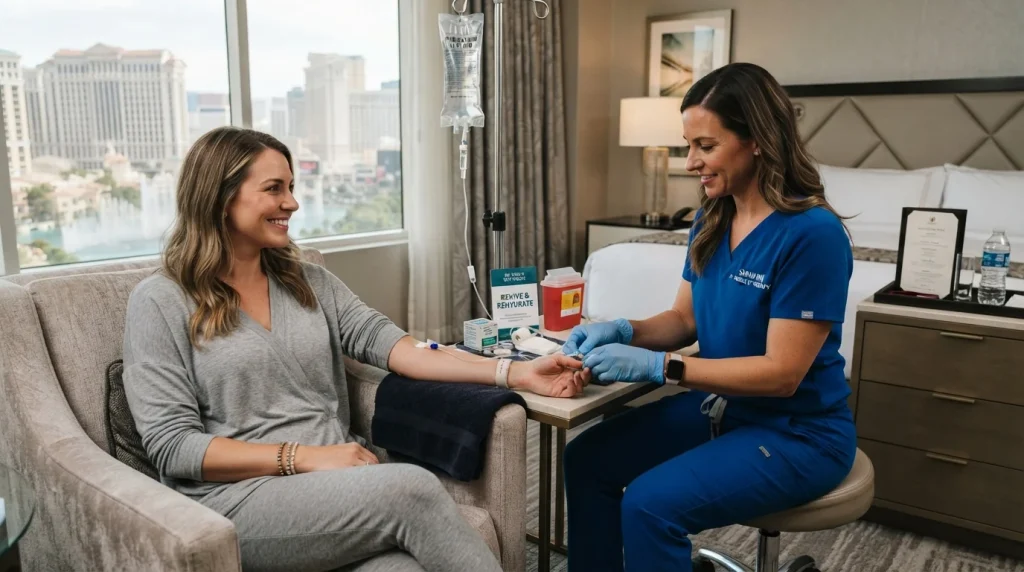
We're open 24 hours and come to homes and hotel rooms across the valley. A typical arrival is 45 to 60 minutes after you book, quickest on the Strip and Downtown and a little longer to Henderson and Summerlin. At peak times, such as weekend mornings, holidays and convention weeks, it can stretch to 90 minutes. The person who arrives is one of our licensed nurses or REMTs.
If a drip fits tonight, our vitamin drips page sets the three vitamin drips side by side, lists the fluid-only drip with them, and takes the booking.
Nevada's nursing board requires a nurse to have an order from a licensed practitioner who has assessed you before starting an IV outside a hospital, and to check for allergies and anything that rules the treatment out. So expect questions before anything goes in. If your answers line up with a warning sign from the first section, a drip isn't the next step.
This flu season in Clark County
The Southern Nevada Health District reported the county's first flu death of the 2026-27 season on September 24: a man in his 50s with underlying health conditions. The district called a death this early concerning. It also said it's too early to predict how severe the season will be. Its active flu surveillance runs from October 4 to May 22, with a report every week.
By May 23, 2026, the district had counted 1,367 flu hospitalizations and 50 flu deaths in Clark County for 2025-26, and nearly half of those hospitalizations, 667, were adults 65 and older. Flu typically peaks between December and February, so most of this season is still ahead of us.
No drip prevents the flu. The flu shot is what lowers your risk of catching it, and the CDC recommends one for everyone 6 months and older, ideally by the end of October. If a drip before a trip is what you had in mind, what a vitamin drip can do for someone who isn't sick yet is a separate question from this one.
What else people ask when they're sick
Sources and References
- Centers for Disease Control and Prevention. Treatment of Flu. Updated September 2, 2025.
- Centers for Disease Control and Prevention. Treating Flu with Antiviral Drugs. Updated June 26, 2026.
- Centers for Disease Control and Prevention. Flu: What To Do If You Get Sick. Updated August 30, 2024.
- Centers for Disease Control and Prevention. Signs and Symptoms of Flu. Updated August 26, 2024.
- Centers for Disease Control and Prevention. Who Needs a Flu Vaccine. Updated September 18, 2025.
- Centers for Disease Control and Prevention. How Flu Spreads. Updated September 17, 2024.
- Centers for Disease Control and Prevention. Manage Common Cold. Updated March 11, 2026.
- Centers for Disease Control and Prevention. Vaccine Information Statement: Influenza (Flu) Vaccine (Inactivated or Recombinant). January 31, 2025.
- MedlinePlus, National Library of Medicine. Dehydration. Updated December 29, 2023.
- Southern Nevada Health District. Health District reports first flu-related death of the season. September 24, 2026.
- Southern Nevada Health District, Office of Epidemiology. Weekly Influenza Surveillance Snapshot, MMWR Week 20 (May 17 to May 23, 2026).
- Nevada State Board of Nursing. Practice Decision: RN Scope in Out of Hospital Administration of IV Solutions and Medications. Approved by the Board November 18, 2020.
- Hemilä H, Chalker E. Vitamin C for preventing and treating the common cold. Cochrane Database of Systematic Reviews. 2013. CD000980.pub4.
- Nault D, Machingo TA, Shipper AG, et al. Zinc for prevention and treatment of the common cold. Cochrane Database of Systematic Reviews. 2024. CD014914.pub2.