Two things decide whether insurance, an HSA or an FSA pays for a mobile IV: who sends the bill, and why you're having the drip. The first settles the insurance question quickly. The second takes longer, and your HSA or FSA card can't answer it for you.
Does insurance cover IV therapy?
When the IV is treatment, it can. HealthCare.gov defines medically necessary care as "health care services or supplies needed to diagnose or treat an illness, injury, condition, disease or its symptoms and that meet accepted standards of medicine." Health plans pay for care that fits that definition when a provider they work with gives it and bills them.
So the reason matters, and so does who bills. A drip you book to recover after a long night, or to feel more awake after a flight, isn't care needed to treat an illness. A plan has nothing to pay for there, wherever you get the drip.
Will insurance pay for IV hydration?
It can, as part of treating an illness. If a clinician treating you gives you IV fluids and bills your plan, the plan can pay its share of that care. A Hydration drip booked with us, $199 for a 45-minute treatment, goes on your card rather than to a plan, even on a day you're sick.
What decides whether your HSA or FSA can pay
The IRS decides, based on what the money paid for. We take HSA and FSA cards like any other card, and the card going through doesn't settle whether you're allowed to spend that money on a drip.
IRS Publication 502 describes medical expenses as "the costs of diagnosis, cure, mitigation, treatment, or prevention of disease." It leaves out "expenses that are merely beneficial to general health, such as vitamins or a vacation." Vitamins only count when they're "recommended by a medical practitioner as treatment for a specific medical condition diagnosed by a physician."
So your reason decides, not what's in the bag. The same drip can be a medical expense for someone whose clinician recommended it to treat a condition a physician diagnosed, and a general-health purchase for someone booking it to feel better. An FSA uses the same definition, with one more limit: it pays only for the expenses its plan names.
What a doctor's recommendation changes
A written recommendation can change your HSA or FSA answer. That's what the IRS exception for vitamins depends on: a medical practitioner recommending the drip as treatment for a specific condition that a physician has diagnosed. People call that document a letter of medical necessity. Ask the clinician treating the condition for it before you book, so the recommendation comes before the visit it covers.
It won't turn a visit with us into an insurance claim, though.
What a wrong guess costs
Paying with an HSA card takes money out of the account, and IRS Publication 969 counts that as a distribution. A distribution that doesn't pay for a qualified medical expense is added to your taxable income. It may also carry an additional 20 percent tax.
On one of our bills, that looks like this. A Hydration drip is $199, and a visit at 10 PM adds our $99 overnight fee, so the bill is $298. Paid from an HSA for a reason that doesn't qualify, that's $298 of taxable income and $59.60 of additional tax. The additional tax stops applying once you're disabled or 65 or older. The income tax doesn't.
If you aren't sure your reason fits, pay with a regular card. You'll be paying with after-tax money, but you can't end up with a taxable distribution.
What to keep
For an HSA, Publication 969 asks you to keep records showing the money paid only for qualified medical expenses. They stay with your tax records, not your return. For a visit, that means the receipt and, if you have one, the clinician's written recommendation.
An FSA needs paperwork before it pays you back. That's a written statement from a third party showing that the expense happened and what it cost, which is the job a receipt does, plus your statement that no other plan has paid for it.
Paying for the visit yourself
Drips on our core menu cost $150 to $350. The Hangover IV, for example, is $250 for 45 minutes. Each add-on is $35, and the $99 overnight fee applies to visits from 8 PM to 7 AM. You pay a $50 deposit when you book, and it counts toward your total. Tips are up to you and are never built into a price. We also take Apple Pay and Google Pay, debit cards, and Visa, Mastercard, American Express and Discover.
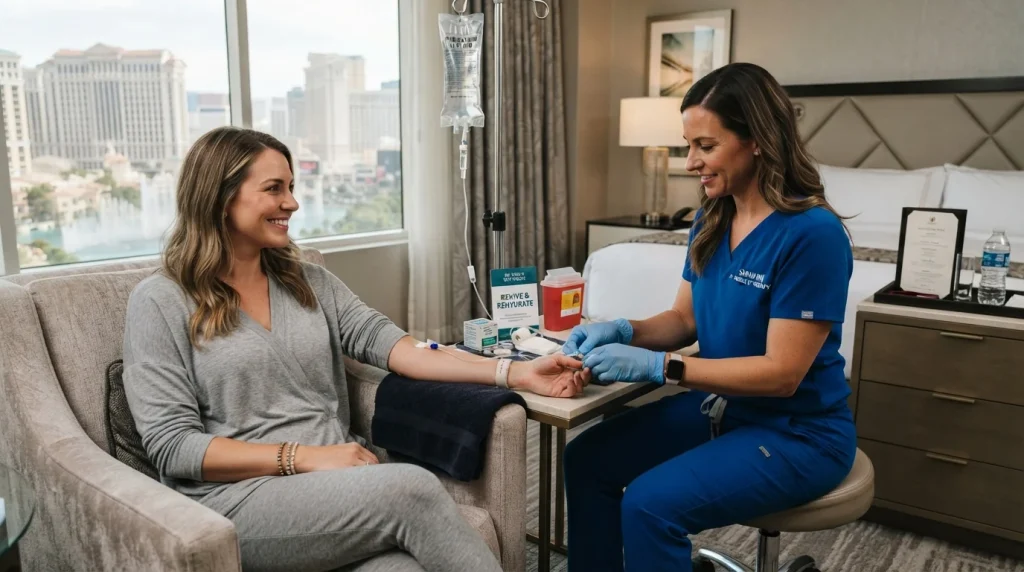
The price covers what happens during a visit: a licensed nurse or REMT travels to you, at home or in your hotel. Whether that's worth paying for yourself is your call, and it turns on whether mobile IVs really work for the reason you're booking.
When you've decided, every drip and shot we offer is listed on one page with its price, and you can book from there.
What else to know before you pay
Sources and References
- HealthCare.gov. Medically necessary. Glossary. Read October 12, 2026.
- Internal Revenue Service. Publication 502, Medical and Dental Expenses. For 2025 returns. Page last reviewed April 30, 2026.
- Internal Revenue Service. Publication 969, Health Savings Accounts and Other Tax-Favored Health Plans. For 2025 returns. Page last reviewed April 30, 2026.