Heat stroke symptoms in Las Vegas often show up later than people expect, because dry desert air hides how much fluid the body is losing. The sign that separates heat stroke from heat exhaustion is confusion, not a number on a thermometer.
Here is what to look for, why a Southern Nevada summer raises the risk, and the point where cooling someone down stops being enough. Mild dehydration after heat exposure is the smaller problem, and the one where IV hydration comes up. This is general information, not medical advice, and individual results vary.
- Confusion, slurred speech, agitation, or the person not making sense
- Fainting, a seizure, or any loss of consciousness
- Skin that is hot to the touch, whether it is dry or damp
- A measured body temperature at or above 103°F
- Vomiting that makes it impossible to keep any fluid down
Heat stroke is a medical emergency. IV hydration is supportive care and it is not emergency care. If you suspect heat stroke, if symptoms are severe, or if the person is pregnant, call 911 or go to an emergency department. Do not wait to see whether it passes.
Why Heat Stroke Matters in Southern Nevada
Heat is the deadliest weather hazard in this region, and the local numbers are specific enough to be worth knowing.
How often heat kills in Clark County
The Southern Nevada Health District recorded 284 heat-associated deaths in Clark County in 2025, down roughly 45 percent from the 513 recorded in 2024. In the same year the county logged 2,217 heat-related emergency department visits. Both the deaths and the emergency visits peaked in August, which is later in the summer than most people expect.
You may also see a higher figure of 298 from the Clark County Office of the Coroner and Medical Examiner. Both are correct. The coroner counts deaths it investigated, which can include people who died outside Clark County, while the health district counts deaths within the county. The gap is a difference in what is counted, not a disagreement.
Who is most at risk
Risk concentrates in people over 65, in infants and young children, in anyone working or exercising outdoors, and in people whose homes lose air conditioning during a heat wave. Certain medications, including some blood pressure and psychiatric prescriptions, reduce the body's ability to shed heat. Children heat up faster than adults because they have more surface area relative to their size and sweat less efficiently, which is why heat illness in children follows a faster curve than it does in a healthy adult.
Why a Las Vegas Summer Is Different
Plenty of American cities get hot. Three things make this valley behave differently, and each one removes a defense the body normally relies on.
Dry air hides how much fluid you are losing
Sweating cools you because the sweat evaporates. In humid climates it sits on the skin, which gives you an obvious signal that you are losing water. At Mojave humidity, sweat evaporates almost as fast as it appears.
Why you can be dehydrated without feeling sweaty
The cooling still happens. The evidence of it does not. People here underestimate their fluid loss because the wet shirt never arrives, and there is a second, quieter loss on top of it: every breath of dry air has to be humidified before it reaches the lungs. Reading about preventing dehydration in Las Vegas is worth doing before a long day outside, not after one.
The city does not cool down at night
Asphalt, concrete and dark rooftops absorb heat through the day and release it after sunset. Harry Reid International Airport averages between five and 15 degrees warmer than the surrounding rural desert on clear nights, and the valley's overnight lows have been climbing faster than its daytime highs.
Why overnight lows matter more than daytime highs
The body repairs heat strain during the cool part of the day. When the low stays in the high 80s or above, that repair window closes. Heat strain then carries over from one day to the next, which is why the risk in a multi-day heat wave is higher on day four than on day one at the same afternoon temperature.
Visitors arrive without acclimatization
Acclimatizing to heat takes most people one to two weeks of gradual exposure. A visitor who lands from a mild climate and spends the afternoon at a pool has none of that adaptation, and alcohol adds a diuretic effect on top of it. Someone enjoying a day out is simply operating with less margin than a resident who has spent the summer here. The same applies to residents in early June. Advice on staying hydrated through a Las Vegas summer is most useful in the first weeks of the season.
Heat Stroke Signs and Symptoms
Heat stroke presents with a core body temperature at or above 103°F, skin that is hot to the touch and may be red and either dry or damp, a throbbing headache, confusion or slurred speech, nausea, dizziness, a rapid and strong pulse, and fainting. Any one of the neurological signs is enough to act on.
Early warning signs most people miss
Before the picture is obvious there is usually heavy sweating, muscle cramps, a headache that will not settle, and unusual tiredness or irritability. Cold, clammy skin and a fast, weak pulse point toward heat exhaustion. This is the stage where moving indoors and drinking fluids still works, and the stage most people talk themselves out of taking seriously.
The one to watch for in this climate is thirst that keeps returning no matter how much water someone drinks. Water alone replaces volume but not the salts lost in sweat, which is part of how electrolytes actually work to hold that fluid where the body needs it.
Symptoms that mean heat stroke, not heat exhaustion
Three changes mark the crossing. Thinking becomes disordered, and the person seems confused, agitated, unsteady, or simply not themselves. Sweating may stop, leaving skin that is hot and dry, because the body has run out of fluid to sweat with. And the core temperature climbs to 103°F or higher.
The dry-skin sign matters here. In humid climates heat stroke often arrives with the person still soaked. In a desert it frequently arrives dry, which reads to a bystander as an improvement when it is the opposite.
Heat exhaustion vs heat stroke at a glance
| Sign | Heat exhaustion | Heat stroke |
|---|---|---|
| Mental state | Alert and oriented | Confused, slurred speech, or unconscious |
| Skin | Cool, pale, clammy | Hot to the touch, red, dry or damp |
| Sweating | Heavy | May have stopped entirely |
| Body temperature | Normal or mildly raised | 103°F or higher |
| Pulse | Fast and weak | Fast and strong |
| What to do | Move to a cool place, rest, sip fluids | Call 911, then cool the person immediately |
What to Do While You Wait for Help
Call 911 first. Everything below happens while the ambulance is on its way, not instead of calling one.
Cool the person first
Cooling is the priority, ahead of everything except the call. Move the person into shade or air conditioning. Remove extra clothing. Apply cool water to the skin, or cool wet cloths on the neck, armpits and groin, where large blood vessels run close to the surface. A cool bath works if the person is fully conscious. Keep going until help arrives, and tell the paramedics what you have already done.
What not to do
Do not give fluids by mouth to anyone who is confused, drowsy, or not fully awake, because they can choke. Do not use alcohol rubs. Do not give fever medication such as ibuprofen or acetaminophen, which does nothing for heat stroke because the problem is not a fever. And do not put the person in a car and drive to a hospital if paramedics are coming, since cooling on scene is more valuable than the time saved.
When fluids by mouth are enough
If the person is alert, oriented, sweating, and able to hold a normal conversation, this is heat exhaustion territory. Shade, rest, and steady sips of water with some electrolytes usually turn it around within an hour. If they are no better after that hour, or if they cannot keep fluids down, treat it as something more than heat exhaustion.
Common Myths About Heat Stroke
Three ideas circulate every summer in this valley, and each one delays the moment someone acts.
Myth: dry heat is safer than humid heat
Dry heat is more comfortable, which is not the same thing. Evaporation works better in dry air, so a given temperature feels less oppressive here than it would on the Gulf Coast. The cost is that the fluid leaves faster and leaves no trace, and once someone is dehydrated enough that sweating slows, the same dryness that felt pleasant offers no protection at all.
Myth: if you are sweating, you are fine
Sweating means the body still has fluid to spend. It does not mean the core temperature is under control, and people do develop heat stroke while still sweating. The National Weather Service lists skin that is hot to the touch and either dry or damp among the signs, precisely because the damp version catches people out.
Myth: only people working outside get heat stroke
Outdoor workers are a high-risk group, but Clark County's heat deaths include people who were indoors when the air conditioning failed, older adults living alone, and visitors who spent an afternoon at a pool. A hot apartment during a multi-day heat wave with overnight lows in the high 80s is a genuine exposure, not a mild inconvenience.
When to Get Medical Help
The decision splits cleanly, and knowing which side you are on is most of the work.
Signs you need emergency care
Call 911 or go to an emergency department for confusion, slurred speech, fainting, a seizure, skin that is hot to the touch, a temperature at or above 103°F, or vomiting that makes fluids impossible. Do the same for a pregnant person with heat symptoms, for an infant or young child who is unusually drowsy or has stopped producing wet diapers, and for anyone whose symptoms are not clearly improving after an hour out of the heat.
When rehydration support is reasonable
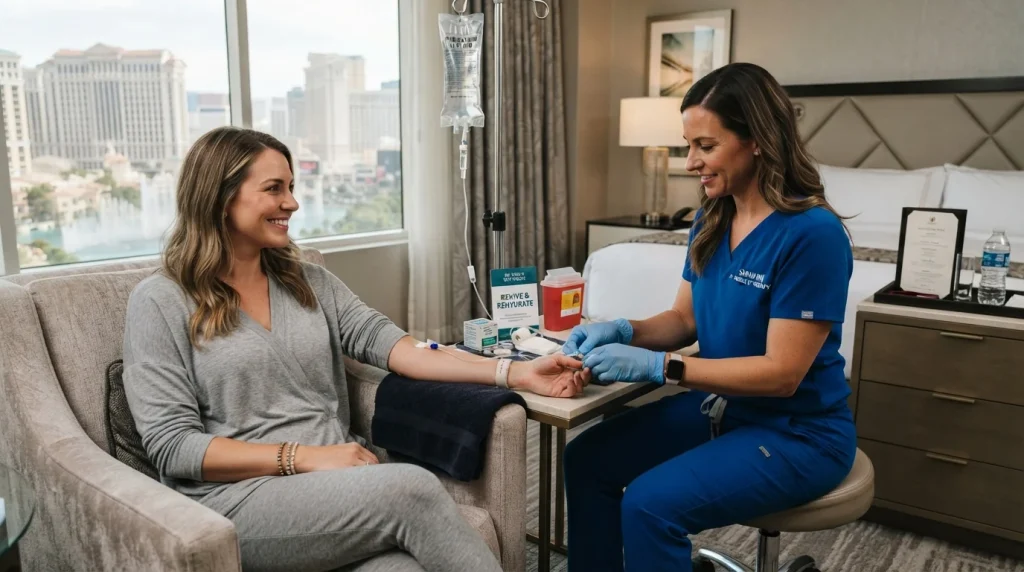
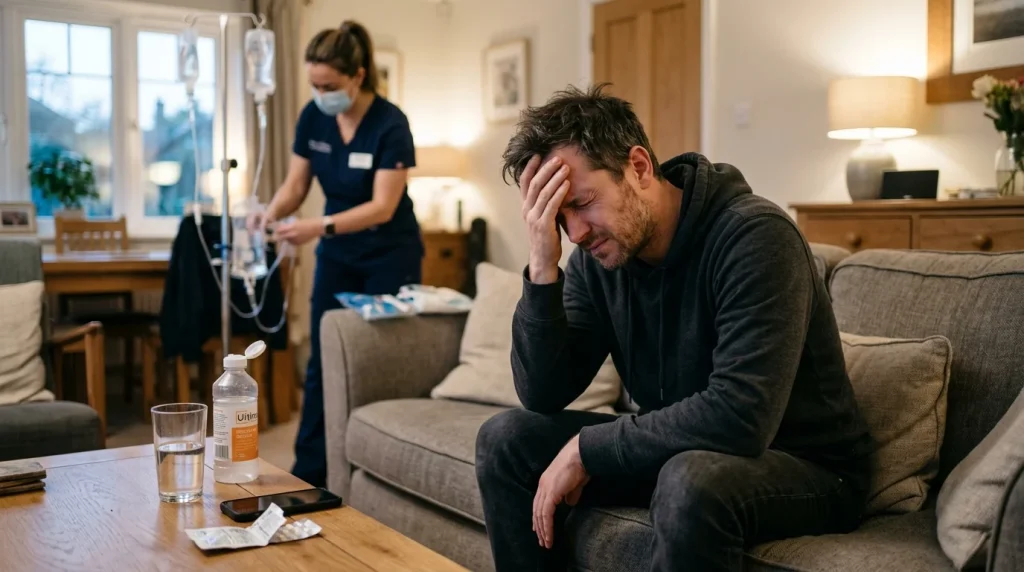
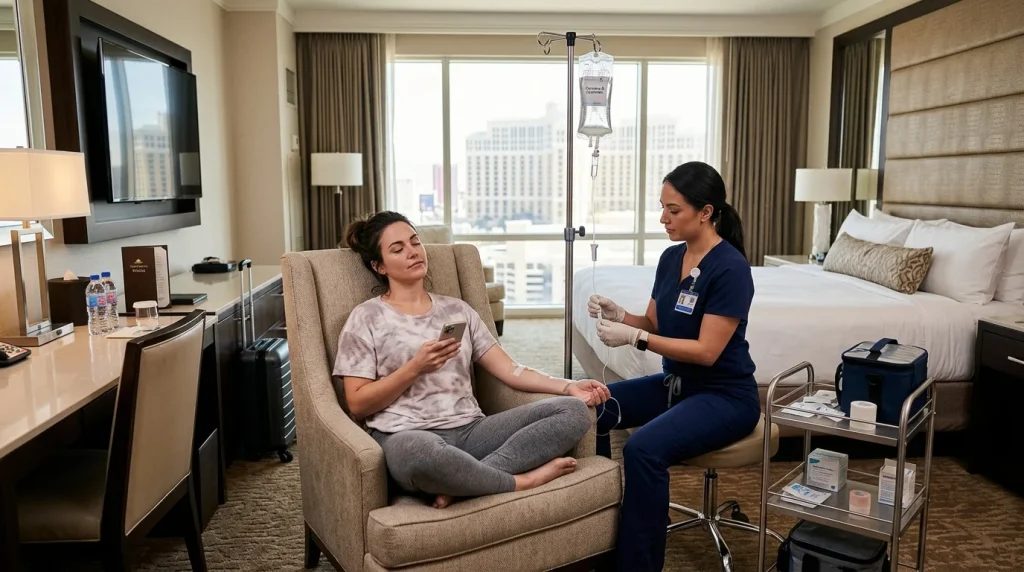
For mild dehydration after heat exposure, in someone who is alert and stable, fluids by mouth are usually enough and are the right first move. Where a person cannot keep fluids down, IV fluids for dehydration are one option, because they bypass digestion entirely and do not ask an unsettled stomach to cooperate. Las Vegas Mobile IV Therapy provides that as an in-home service across the Las Vegas metro, administered by licensed nurses and NREMTs under medical oversight by our Medical Director, Dr. Daniel Olivero, MD.
To be direct about the limits: IV hydration is supportive care and it is not a treatment for heat stroke. Statements about IV therapy on this page have not been evaluated by the Food and Drug Administration. Individual results vary, and many clients report feeling better within 30 to 60 minutes. If heat stroke is a possibility, the answer is 911, not a booking.
Sources and References
- Centers for Disease Control and Prevention. First Aid for Heat Illness. Symptom criteria, the 103°F threshold, and the cooling-first sequence.
- Southern Nevada Health District. Heat-Associated Deaths and Emergency Department Visits Reports. Clark County deaths and emergency department visits by year.
- National Weather Service. Heat Illness safety. Signs of heat stroke and heat exhaustion, including skin presentation.
- Las Vegas Review-Journal. Heat death toll in Southern Nevada. The Clark County Coroner and Medical Examiner count and how it differs from the health district figure.
- Las Vegas Sun. Record high temperatures raising concerns for Las Vegas. Climate Central data on the urban heat island and the valley's overnight warming.