On our menu, an exosome IV costs $1,440 and a stem cell IV costs $4,999. The usual pitch says the pricier one is the real thing and exosomes are the light version. That's not quite right. Given by IV, the two are closer than the price gap suggests, and what they have in common matters more than what divides them.
The two IVs, side by side
The difference starts with what's in the bag. A stem cell IV is a dose of living cells, usually from a donor and often mesenchymal stem cells (MSCs) grown from donated tissue such as umbilical cord, bone marrow or fat. An exosome IV holds no cells at all. Exosomes are particles, far smaller than a cell, that cells release to carry proteins and genetic material to other cells, and the ones sold as products are usually collected from donor cells grown in a lab.
What happens after the IV is where the usual pitch breaks down. IV stem cells stop in the lungs first. A 2021 review of 109 studies in animals and people found that stem cells given by IV gathered in the lungs before moving on to the liver, spleen and kidneys. In mice, living stem cells were found in the lungs for up to a day and in no other organ. That tracking gives no sign of them settling in a sore knee and turning into cartilage.
So whatever IV stem cells do, they do indirectly. In lab and animal studies, researchers have traced much of what infused stem cells do to the particles they release, exosomes in particular. That leaves the "cells rebuild, exosomes only signal" contrast with little to stand on once both go into a vein. The real difference is narrower: one puts living cells into your bloodstream and the other doesn't. Across 55 randomized trials of IV stem cells in 2,696 patients, the people given the cells ran fevers more often than those who weren't, and no other harm stood out.
| Exosome IV | Stem cell IV | |
|---|---|---|
| What goes into the vein | Particles released by donor cells, no living cells | Living cells, usually from a donor |
| Treatment time here | 45 minutes, booked as a 60-minute slot | 60 minutes |
| Price here | $1,440 | $4,999 |
| Before anything is scheduled here | A good-faith exam and a provider's approval | A good-faith exam and a provider's approval |
| FDA approval for the IV we offer | None | None |
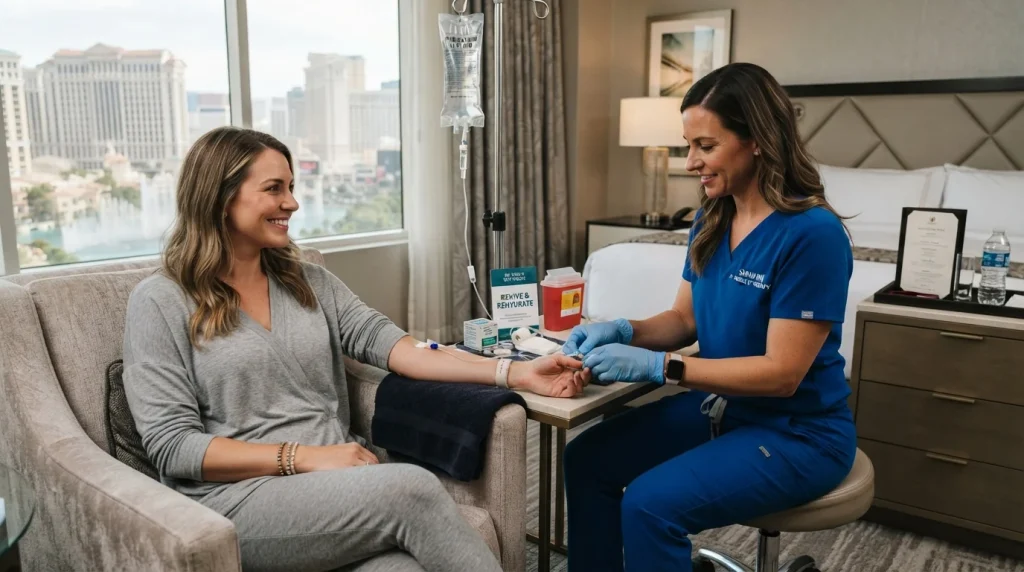
Like everything we offer, the exosome IV and the stem cell IV are both given where you're staying, at home or in a hotel. Neither can be booked online: both need a good-faith exam and a provider's approval before anything is scheduled.
Are exosomes legal in the USA?
No exosome product has FDA approval. Since December 2019, the FDA's position has been that exosomes used to treat diseases and conditions in people are drugs and biological products, which need its approval before they're sold for that. Its July 2020 consumer alert repeated it. The agency has kept acting on it: in December 2024 and May 2025 it sent warning letters to two companies selling exosome products, one marketed as "100 Billion Exosomes" from umbilical cord stem cells, calling them unapproved new drugs and unlicensed biological products.
It helps to see what an approval looks like. The FDA has approved stem cell products made from umbilical cord blood, for disorders that affect how the body makes blood. On December 18, 2024, it approved its first mesenchymal stem cell product: an IV, given as eight infusions over four weeks, for children with a severe complication of a bone marrow transplant. One product, one condition, trial data behind it. No regenerative product is approved for joint pain, chronic pain or fatigue, the 2020 alert says. (The FDA's consumer pages, last updated in April 2024, still call the cord blood products the only approved stem cell products.)
Neither IV we offer is FDA-approved. Both are experimental, and that's the honest word for them.
PRP is in a different position. It's your own blood, prepared at the visit with a device the FDA has cleared, and using it in a joint is an off-label use, which clinicians are allowed to make.
The dark side of exosome therapy: what has actually gone wrong
The clearest case is from Nebraska. In December 2019, the FDA reported serious adverse events in Nebraska patients treated with unapproved products marketed as containing exosomes. Nebraska's health department said the same day that people there had become ill after a product made from C-section placentas, and that some of them had bacteria in their blood. The FDA also noted that some clinics offering exosomes were the same ones selling unapproved stem cell products.
Its guidance for patients lists the harms it has had reports of with unapproved regenerative products in general:
- Infections, including life-threatening blood infections
- Unwanted immune reactions to the product
- Contamination with bacteria, viruses or mold during processing
- Tumor formation
- Blindness
Then there's the question of what's in the bag. A 2023 study of 114 companies in 28 countries selling these products directly to the public found that most used donor stem cells from sources they didn't disclose. Even the unit gets muddled. Exosomes aren't cells, so a dose is counted in particles, and a listing that counts them in cells is describing the product wrong.
The trials don't settle much yet. A 2026 systematic review found 25 published clinical studies of these particles, only 7 of them controlled, with COVID-19 lung disease and wound healing the most studied uses. It called the safety conclusions preliminary.
Nothing is scheduled here until the good-faith exam is done and a provider approves the infusion. Bring your full health history and a list of your medicines, and ask the questions the FDA tells patients to ask, plus a few of your own:
- Has the FDA reviewed this treatment? If it's being given in a study, what's the IND (Investigational New Drug) number?
- What exactly is in the bag: which donor tissue, which company made it, and how each batch was tested?
- How is the dose counted, and how much is in this infusion?
- What reactions has the provider seen, and who do you call if something feels wrong afterward?
Which is better, PRP or exosomes?
They do different jobs. PRP, platelet-rich plasma, is your own blood, spun to concentrate the platelets and injected back into one spot, such as a knee or a tendon. An exosome IV is a whole-body infusion of particles from someone else's cells. So "better" depends on the job you have in mind.
PRP has far more human trials behind it. The results are mixed. In RESTORE, a placebo-controlled trial published in JAMA in 2021, 288 adults with knee arthritis got three weekly injections of either PRP or salt water, and at 12 months their pain and cartilage didn't differ between the groups. A smaller trial of 87 knees found PRP better than both hyaluronic acid and salt water a year later.
The direct comparisons we found were on skin and hair, not IVs. In one investigator-blinded trial on sun-damaged facial skin, with each applied after microneedling, both improved the skin about equally.
We don't offer PRP. If your goal is one sore joint or tendon, that's a conversation for a clinic that does injections, and PRP, with its longer trial record, is one of the options to ask about there. If you want a whole-body infusion, PRP isn't the alternative, and no trial compares the two that way.
How many sessions anyone can honestly plan
No trial sets a number of exosome sessions for wellness, so any number you're quoted is a provider's plan, not a finding. The trials that do exist gave fixed courses to people who were ill. In the ExoFlo trial, 102 people hospitalized with COVID-19 lung failure were randomized to placebo or to two IV doses of a product made from particles released by bone marrow stem cells, given on days 1 and 4. The approved stem cell product is given as eight infusions over four weeks. And a 2025 review of 66 registered exosome trials found they didn't even measure doses in the same units. Nobody agrees on a dose yet.
Here, each exosome IV is one 45-minute infusion at $1,440. Two come to $2,880. Three come to $4,320, close to the $4,999 of a single stem cell IV. If a provider suggests more than one, ask how many, how far apart, and what would tell you to stop.
Choosing, if you still want one
Start with the goal. If it's one joint or tendon, an IV is the wrong thing to compare: look at PRP or another injection at a clinic that does them. That isn't us.
If you want a whole-body infusion, and you accept that neither option is approved or proven for wellness, the two IVs trade off cleanly. The exosome IV costs $1,440, less than a third of the stem cell IV, and puts no living cells into your vein. The stem cell IV costs $4,999, and stem cell infusions as a category have far more human safety data behind them, from trials in people being treated for an illness. Pick the trade-off you can live with.
Not sure? Take your questions about what's in the bag to the exam.
If you've weighed all of it and still want the exosome IV, the next step is a phone call, not a booking button.
Other questions about exosome and stem cell IVs
Sources and References
- U.S. Food and Drug Administration. Public Safety Notification on Exosome Products. December 6, 2019.
- Nebraska Department of Health and Human Services. Risk Associated with Unapproved Products Derived from Stem Cells, Placenta, and Umbilical Cord Blood (Health Alert Network advisory). December 6, 2019.
- U.S. Food and Drug Administration. Consumer Alert on Regenerative Medicine Products Including Stem Cells and Exosomes. July 22, 2020.
- U.S. Food and Drug Administration. Important Patient and Consumer Information About Regenerative Medicine Therapies. June 3, 2021.
- U.S. Food and Drug Administration. FDA approves remestemcel-L-rknd for steroid-refractory acute graft versus host disease in pediatric patients. December 18, 2024.
- U.S. Food and Drug Administration. Warning Letter CBER-24-681586, Evolutionary Biologics Inc. December 30, 2024.
- U.S. Food and Drug Administration. Warning Letter CBER 25-700749, Supreme Rejuvenation, LLC. May 5, 2025.
- Sánchez-Díaz M, Quiñones-Vico MI, Sanabria de la Torre R, et al. Biodistribution of Mesenchymal Stromal Cells after Administration in Animal Models and Humans: A Systematic Review. Journal of Clinical Medicine, 2021.
- Eggenhofer E, Benseler V, Kroemer A, et al. Mesenchymal stem cells are short-lived and do not migrate beyond the lungs after intravenous infusion. Frontiers in Immunology, 2012.
- Lotfy A, AboQuella NM, Wang H. Mesenchymal stromal/stem cell (MSC)-derived exosomes in clinical trials. Stem Cell Research & Therapy, 2023.
- Thompson M, Mei SHJ, Wolfe D, et al. Cell therapy with intravascular administration of mesenchymal stromal cells continues to appear safe: An updated systematic review and meta-analysis. EClinicalMedicine, 2020.
- Asadpour A, Yahaya BH, Bicknell K, Cottrell GS, Widera D. Uncovering the gray zone: mapping the global landscape of direct-to-consumer businesses offering interventions based on secretomes, extracellular vesicles, and exosomes. Stem Cell Research & Therapy, 2023.
- Duong A, Giguère P, Shorr R, Allan DS. A systematic review of published clinical studies using cell-derived extracellular vesicles: A focus on efficacy in COVID-19 and wound healing. Current Research in Translational Medicine, 2026.
- Bennell KL, Paterson KL, Metcalf BR, et al. Effect of Intra-articular Platelet-Rich Plasma vs Placebo Injection on Pain and Medial Tibial Cartilage Volume in Patients With Knee Osteoarthritis: The RESTORE Randomized Clinical Trial. JAMA, 2021.
- Lin KY, Yang CC, Hsu CJ, Yeh ML, Renn JH. Intra-articular Injection of Platelet-Rich Plasma Is Superior to Hyaluronic Acid or Saline Solution in the Treatment of Mild to Moderate Knee Osteoarthritis. Arthroscopy, 2019.
- Beitzel K, Allen D, Apostolakos J, et al. US Definitions, Current Use, and FDA Stance on Use of Platelet-Rich Plasma in Sports Medicine. The Journal of Knee Surgery, 2015.
- Estupiñan B, Ly K, Goldberg DJ. Adipose Mesenchymal Stem Cell-Derived Exosomes Versus Platelet-Rich Plasma Treatment for Photoaged Facial Skin: An Investigator-Blinded, Split-Face, Non-Inferiority Trial. Journal of Cosmetic Dermatology, 2025.
- Lightner AL, Sengupta V, Qian S, et al. Bone Marrow Mesenchymal Stem Cell-Derived Extracellular Vesicle Infusion for the Treatment of Respiratory Failure From COVID-19: A Randomized, Placebo-Controlled Dosing Clinical Trial. Chest, 2023.
- Wang Y, Zhu J, Ma Q, et al. Trends in mesenchymal stem cell-derived extracellular vesicles clinical trials 2014 to 2024: is efficacy optimal in a narrow dose range? Frontiers in Medicine, 2025.
- Tieu A, Lalu MM, Slobodian M, et al. An Analysis of Mesenchymal Stem Cell-Derived Extracellular Vesicles for Preclinical Use. ACS Nano, 2020.
- Tolomeo AM, Zuccolotto G, Malvicini R, et al. Biodistribution of Intratracheal, Intranasal, and Intravenous Injections of Human Mesenchymal Stromal Cell-Derived Extracellular Vesicles in a Mouse Model for Drug Delivery Studies. Pharmaceutics, 2023.
- Welsh JA, Goberdhan DCI, O'Driscoll L, et al. Minimal information for studies of extracellular vesicles (MISEV2023): From basic to advanced approaches. Journal of Extracellular Vesicles, 2024.
- U.S. Food and Drug Administration. Investigational New Drug Applications (INDs) for CBER-Regulated Products. September 4, 2026.
- U.S. Food and Drug Administration. Is It Really 'FDA Approved'? May 4, 2026.